On this page
When Log4Shell (CVE-2021-44228) was disclosed in December 2021, most security teams spent days or weeks just finding out where Log4j was running. The library was buried inside vendor products, Java applications and appliances that nobody had inventoried. Teams with a current software bill of materials searched for one component name and had their answer the same day.
That is the whole idea behind an SBOM. This guide explains what one contains, the formats and types you will meet, how it connects to vulnerability management through VEX, and why regulators and enterprise buyers in India, the Gulf, Europe and the US now ask for one.
What an SBOM is, in plain terms
Think of the ingredients label on packaged food. An SBOM is the ingredients label for software. Modern applications are mostly assembled, not written: a typical web application pulls in hundreds of open-source packages, and each of those pulls in more. Your developers may have chosen 40 direct dependencies; the build may contain 600 components once transitive dependencies are counted.
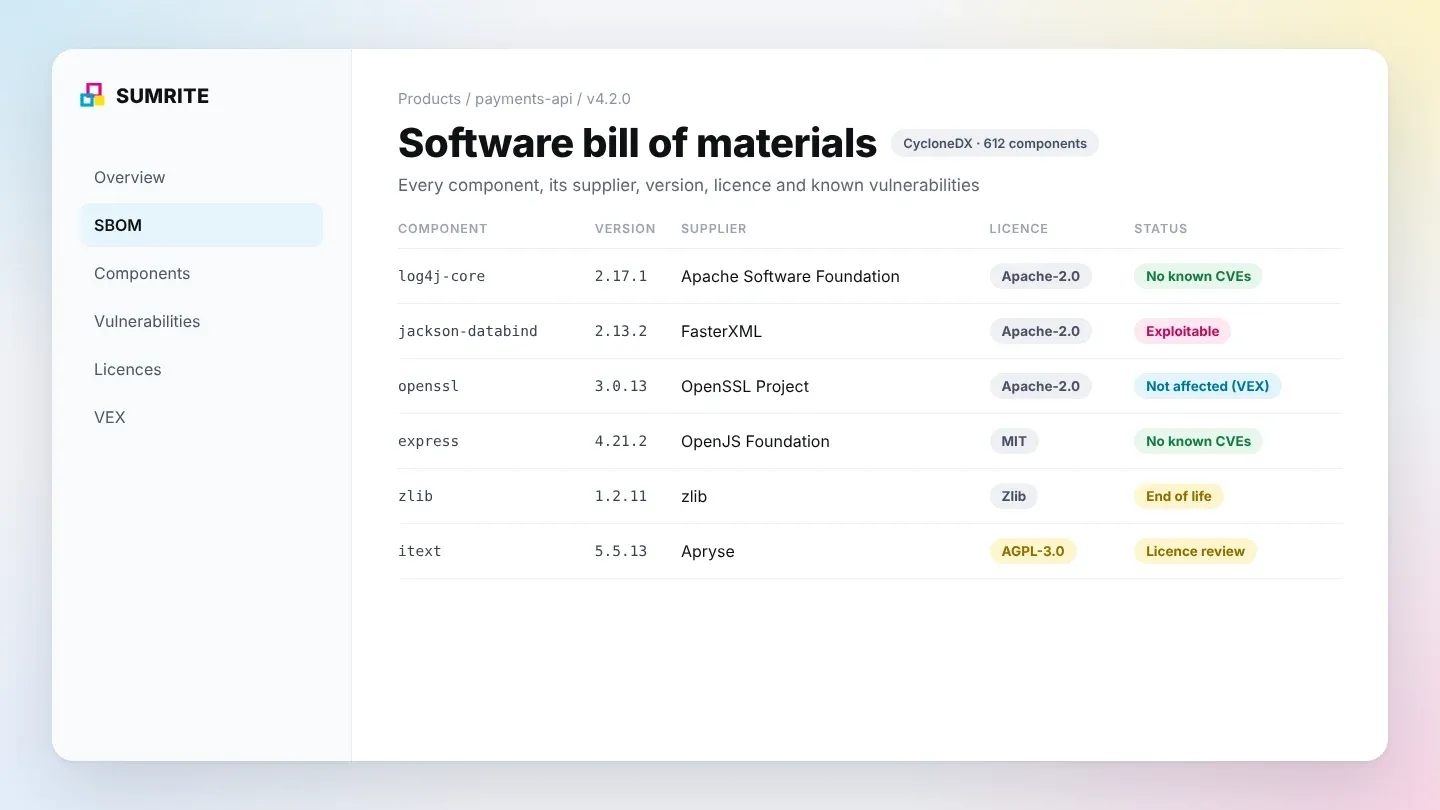
An SBOM records all of them in a structured file that tools can read. It does not contain your source code, and it is not a vulnerability report. It is an inventory, and its value comes from what you do with it.
What goes into an SBOM
In July 2026, CISA, together with the NSA, the FBI and international partners, published the 2026 Minimum Elements for a Software Bill of Materials, replacing the 2021 NTIA baseline. The core fields look like this:
- SBOM author
- Who created the SBOM data
- Timestamp
- When the SBOM was generated
- Supplier
- Who created or maintains each component
- Component name
- For example log4j-core or openssl
- Version
- The exact version shipped, for example 2.17.1
- Unique identifiers
- Package URL (purl) or CPE, so tools can match the component reliably
- Dependency relationships
- Which component includes which
- Component hash (new in 2026)
- A cryptographic hash that proves the file is the one listed
- Licence (new in 2026)
- The licence each component is distributed under
- Tool name (new in 2026)
- The tool that generated the SBOM
- Generation context (new in 2026)
- Whether the SBOM was made from source, a build or a binary
India’s CERT-In goes further. Its Technical Guidelines on SBOM, QBOM and CBOM, AIBOM and HBOM (version 2.0, July 2025) list 21 minimum data fields, adding items such as component description, origin (open source or proprietary), end-of-life date, criticality and known vulnerabilities. If you sell to Indian government, public sector or regulated buyers, plan for the CERT-In field list rather than the CISA minimum.
A short SBOM example
Here is one component from a CycloneDX SBOM in JSON. A real file lists every component in the same way:
{
  "bomFormat": "CycloneDX",
  "specVersion": "1.6",
  "metadata": {
    "timestamp": "2026-11-09T10:15:00Z",
    "tools": { "components": [{ "type": "application", "name": "syft" }] },
    "component": { "type": "application", "name": "payments-api", "version": "4.2.0" }
  },
  "components": [
    {
      "type": "library",
      "supplier": { "name": "The Apache Software Foundation" },
      "name": "log4j-core",
      "version": "2.17.1",
      "purl": "pkg:maven/org.apache.logging.log4j/log4j-core@2.17.1",
      "hashes": [{ "alg": "SHA-256", "content": "…" }],
      "licenses": [{ "license": { "id": "Apache-2.0" } }]
    }
  ]
}
The purl (package URL) is the field that makes automation work. It identifies the package type, name and version in one string that vulnerability databases understand.
SPDX vs CycloneDX
There are two formats you will see everywhere. Both are accepted by CISA, CERT-In, the FDA and EU guidance, and most generation tools can write either.
| SPDX | CycloneDX | |
|---|---|---|
| Maintained by | Linux Foundation | OWASP |
| Standard | ISO/IEC 5962 | ECMA-424 |
| Origin | Licence compliance | Application security |
| Vulnerability data | Via external documents and links | Built in, including VEX |
| Also covers | Files, snippets, licences in depth | Services, firmware, hardware, AI models (ML-BOM), cryptography (CBOM) |
| Encodings | JSON, YAML, RDF, tag-value | JSON, XML, Protocol Buffers |
Which should you pick? If a customer or regulator names one, use that. If legal and licence review is the main driver, SPDX is a natural fit. If security teams will consume the SBOM, CycloneDX is usually easier because vulnerability and VEX data live in the same ecosystem. Converting between them is possible, but some detail is lost, so generate natively where you can.
The six types of SBOM
CISA groups SBOMs by the point in the lifecycle where they are generated. The type matters because each one sees different things:
Design
Planned components for a release that does not exist yet. Useful for procurement, weak as evidence.
Source
Generated from source code and lock files. Fast, but can miss what the build actually pulls in.
Build
Generated during the build. The most accurate view of what ships, and the type most regulators expect.
Analyzed
Generated by scanning a finished artefact, such as a container image or firmware. Essential when there is no source.
Deployed
What is installed in an environment, including configuration and other software alongside it.
Runtime
What is actually loaded in memory while the software runs. Shows which components are really used.
Most organisations start with source or build SBOMs from the CI pipeline, and use analyzed SBOMs for third-party software, containers and firmware where they do not have the source.
SBOM and VEX: from inventory to decisions
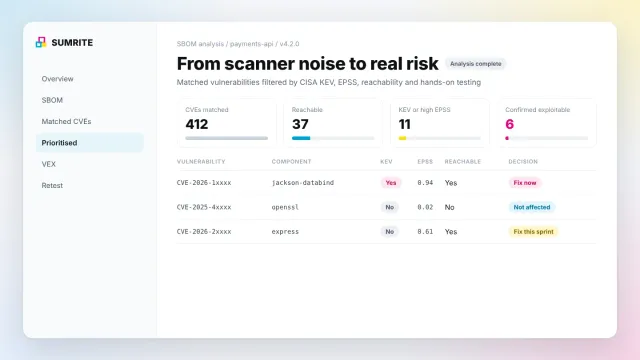
An SBOM on its own creates a new problem. Match 600 components against vulnerability databases and you will often get a hundred or more CVEs, most of which cannot be exploited in your product because the vulnerable function is never called, the feature is disabled, or the code is not even shipped.
VEX (Vulnerability Exploitability eXchange) solves this. A VEX document is a statement from the producer about each vulnerability: not affected, affected, fixed or under investigation, with a justification such as vulnerable code not in execute path. It travels alongside the SBOM, so a customer’s scanner can suppress the noise and focus on what is real. CycloneDX supports VEX natively; OpenVEX and CSAF VEX are the other common formats.
SBOM plus VEX is what buyers want
Enterprise security questionnaires increasingly ask for both. An SBOM alone tells the buyer what is inside. The VEX tells them which of the scanner’s alarms they can ignore, and why. Without it, every buyer runs their own scan and sends you the same long list of CVEs to explain.
Why SBOMs matter now
Faster incident response. When the next Log4Shell or XZ Utils backdoor (CVE-2024-3094) lands, you query your SBOMs for the affected component and versions, and you know your exposure across every product and release.
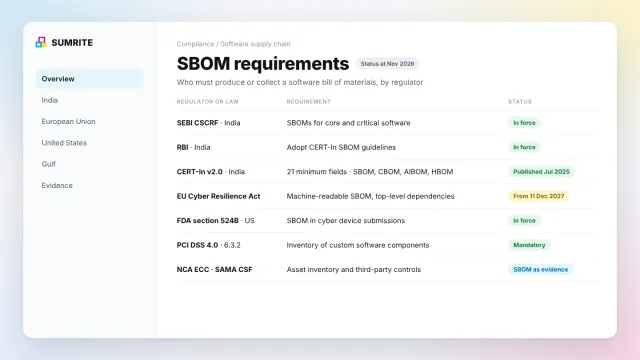
Regulation. SBOMs have moved from good practice to requirement in several places:
- FDA section 524B (US): an SBOM in every premarket submission for a connected “cyber device”
- SEBI CSCRF (India): SBOMs for core and critical software at SEBI-regulated entities, including third-party and SaaS applications
- RBI (India): regulated entities advised to adopt the CERT-In SBOM guidelines
- CERT-In (India): SBOM guidelines for government, public sector and essential services organisations, and their software suppliers
- EU Cyber Resilience Act: an SBOM covering at least top-level dependencies, as part of vulnerability handling, from 11 December 2027
- PCI DSS 4.0 requirement 6.3.2: an inventory of bespoke and custom software and the third-party components inside it
We cover each of these in detail in SBOM requirements in 2026.
Procurement. Banks, government entities and large enterprises in Saudi Arabia, the UAE and India now ask software vendors for SBOMs during due diligence. NCA ECC and SAMA CSF do not name the SBOM, but their asset inventory, trusted-source and third-party controls are hard to evidence without one. If you are a software vendor, a validated SBOM shortens the security review. See what Saudi buyers ask SaaS vendors.
Licence risk. The same inventory shows copyleft or unknown licences that could force you to release source code or block an acquisition.
What an SBOM does not do
Common misunderstandings
An SBOM is not a security test. It will not find a broken access control, an insecure API or a logic flaw in your own code. It is only as good as the tool and process that produced it: SBOMs regularly miss vendored code, statically linked libraries and components copied into the repository by hand. And an SBOM generated once is out of date with the next release.
That is why SBOM work has two halves: generating a complete, accurate SBOM for every release, and analysing it to turn the inventory into decisions. Our SBOM analysis guide walks through the second half step by step, and a penetration test still covers the code your team wrote.
How to get started
- List your products and releases. Start with what is customer-facing or regulated.
- Generate a build SBOM in CI. Open-source tools such as Syft, Trivy and cdxgen produce SPDX or CycloneDX on every build.
- Check the SBOM against the real build. Look for missing transitive dependencies, vendored code and wrong versions.
- Analyse it. Match vulnerabilities and licences, then decide what is exploitable and record it in VEX.
- Ask your suppliers for theirs. Make SBOM delivery a contract term for new software purchases and renewals.
- Keep it current. Regenerate on every release and store each version, because auditors and incident responders need the history.
Sumrite’s SBOM analysis service does this end to end: we generate or validate your SBOMs in SPDX or CycloneDX, find the components that actually put you at risk, confirm exploitability with hands-on testing, and deliver VEX and evidence mapped to CERT-In, SEBI CSCRF, the EU Cyber Resilience Act and FDA 524B, with a retest included.
Sources: CISA, 2026 Minimum Elements for a Software Bill of Materials · CERT-In Technical Guidelines on SBOM, QBOM and CBOM, AIBOM and HBOM v2.0 · SPDX specification · CycloneDX specification · Regulation (EU) 2024/2847, Cyber Resilience Act
Frequently asked questions
What is an SBOM?
An SBOM (software bill of materials) is a formal, machine-readable inventory of the components that make up a piece of software: open-source libraries, third-party packages, frameworks and their dependencies, each with its supplier, version, unique identifier and relationships to other components.
What is the full form of SBOM?
SBOM stands for software bill of materials. The name comes from the bill of materials used in manufacturing, which lists every part that goes into a physical product.
What are the minimum elements of an SBOM?
The 2021 NTIA minimum elements were supplier, component name, version, other unique identifiers, dependency relationship, author of the SBOM data and timestamp. CISA's 2026 Minimum Elements, published with the NSA, the FBI and international partners, keep these and add component hash, component licence, the name of the tool that generated the SBOM and the generation context.
What is the difference between SPDX and CycloneDX?
Both are open, machine-readable SBOM formats accepted by CISA, CERT-In and the FDA. SPDX comes from the Linux Foundation, is published as ISO/IEC 5962 and grew out of licence compliance. CycloneDX comes from OWASP, is standardised as ECMA-424 and was designed for security use cases, including built-in VEX support. Most tools can produce both.
Does an SBOM show vulnerabilities?
Not by itself. An SBOM is an inventory. Vulnerabilities are found by matching its components against databases such as NVD and OSV. A VEX (Vulnerability Exploitability eXchange) document then states which of those vulnerabilities actually affect the product.
Is an SBOM mandatory?
For some organisations, yes. FDA section 524B requires one for connected medical devices, SEBI's CSCRF requires them for core and critical software at regulated entities in India, CERT-In's guidelines apply to government, public sector and essential services, and the EU Cyber Resilience Act requires one for products with digital elements from 11 December 2027.
Who should create the SBOM?
The software producer, ideally automatically in the build pipeline for every release. Buyers should ask suppliers for SBOMs and check them, and organisations should generate their own for in-house applications.
Faisal Khan is a Director at Sumrite, where he oversees penetration testing, risk assessment and compliance engagements for SaaS and enterprise clients.