On this page
- Why is there no fixed price for penetration testing in Saudi Arabia?
- What are the main drivers of penetration testing cost in Saudi Arabia?
- How do NCA and SAMA requirements affect penetration testing cost?
- Which hidden costs do penetration testing quotes in Saudi Arabia leave out?
- How do you get comparable penetration testing quotes in Saudi Arabia?
- Is continuous penetration testing better value than annual testing?
- How Sumrite helps
- Frequently asked questions
Delivered with a verified NCA-registered partner
Sumrite runs penetration testing for Saudi organisations end to end with our verified NCA-registered partner firm, and has served 100+ Saudi clients across Riyadh, Jeddah, Dammam and other cities. Ask for a scoped quote.
Buyers ask about cost first, and they are right to. But a single figure for “a pentest in Saudi Arabia” hides more than it shows, because two quotes for the “same” test often describe different work. This guide explains what actually moves the price, so you can brief vendors properly and compare their quotes fairly. For the regulatory context, start with our pillar guide to penetration testing in Saudi Arabia.
Why is there no fixed price for penetration testing in Saudi Arabia?
There is no fixed price for penetration testing in Saudi Arabia because effort depends on what is tested and how deeply, and that varies more between organisations than any city or market rate. A penetration test is priced on tester time, and tester time follows scope.
A small marketing website and a mobile banking platform with open banking APIs are both “one application”, yet the second can involve many more user roles, workflows and integrations. Published price ranges average those very different jobs together. Treat them as background, not as a budget. Our global VAPT cost and pricing guide explains the same principle outside Saudi Arabia.
What are the main drivers of penetration testing cost in Saudi Arabia?
The main drivers are asset count, application complexity, test perspective, regulatory mapping, cadence, delivery constraints, reporting requirements, retesting and timeline. Each one changes how many tester days the engagement needs.
| Cost driver | Why it moves the price | How to keep it under control |
|---|---|---|
| Number and type of assets | Each web app, API, mobile build and IP range needs its own testing time | Prioritise internet-facing assets first |
| Application complexity | User roles, workflows, integrations and payment flows multiply test cases | Share role lists and API documentation up front |
| Test perspective | Black box, grey box and white box need different effort; authenticated testing takes longer but finds more | Choose grey box for most business apps |
| Regulatory mapping | Mapping to NCA ECC 2-11, SAMA CSF 3.2.4 or CSCC adds reporting work | Tell vendors every framework at once, so one report serves all |
| Cadence | One-off tests, periodic programmes and continuous testing are priced differently | Agree an annual plan rather than ad hoc tests |
| Delivery constraints | On-site or in-Kingdom access, production windows and SOC coordination add effort | Provide test environments where the policy allows |
| Reporting | Bilingual Arabic and English reports and evidence packs take time | Decide which audiences need which language |
| Retesting | Retesting may be included or charged separately | Ask for a retest window in the quote |
| Timeline | Urgent start dates can require more testers in parallel | Book ahead of audit and release dates |
Asset count and complexity
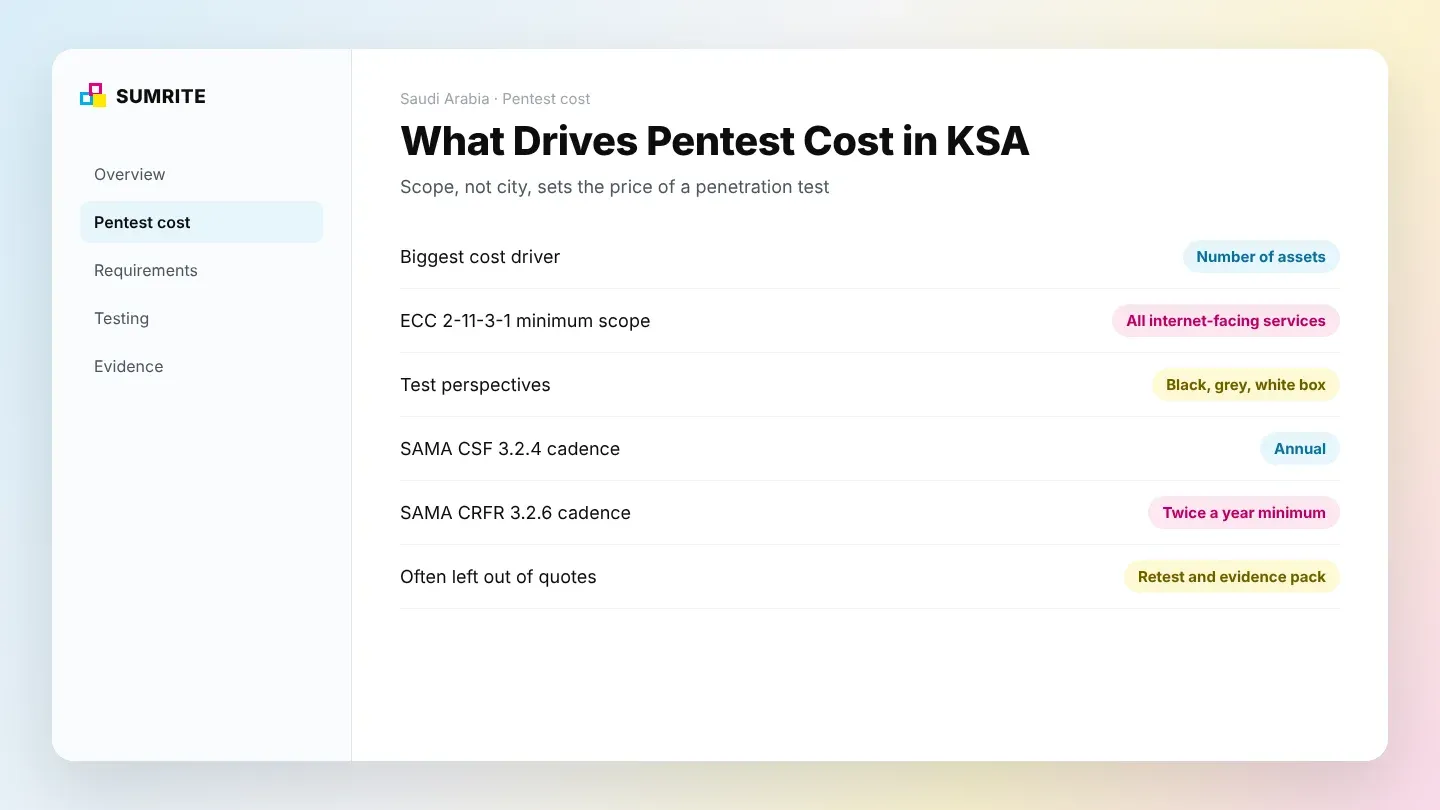
Asset count is the biggest driver. Under NCA ECC-2:2024, control 2-11-3-1 sets the minimum scope as all internet-facing services and their technical components: infrastructure, websites, web applications, smartphone and tablet applications, email and remote access, according to NCA’s published ECC-2:2024 text. An organisation that budgets for “the website” and then discovers it must also test its VPN, webmail and mobile app will see the quote grow. Running a free external check at scan.sumrite.com before requesting quotes helps you count assets accurately.
Test perspective
Black box testing gives testers no information, white box gives full information and grey box gives limited information, as NCA’s Penetration Testing Standard template defines them. Grey box usually gives the best coverage for the effort. Our guide to black box, grey box and white box testing compares them.
How do NCA and SAMA requirements affect penetration testing cost?
NCA and SAMA requirements affect cost mainly through scope and cadence: they decide which assets must be tested and how often, and they require evidence that adds reporting effort. The per-day effort is similar; the number of days changes.
- NCA ECC-2:2024, 2-11-3-1
- Every internet-facing service and component is in scope, including email and remote access
- NCA ECC-2:2024, 2-11-3-2
- Tests run periodically, at an interval your approved policy sets
- SAMA CSF 3.2.4
- Customer and internet-facing services: annual review and penetration test, with follow-up reviews
- SAMA CRFR 3.2.6
- Penetration testing at least twice a year, and after major or critical change
- NCA Penetration Testing Standard template, 2-3
- Critical systems tested every 6 months
The SAMA requirements come from SAMA CSF subdomain 3.2.4 and the Cyber Resilience Fundamental Requirements. A fintech that must test twice a year will spend more across the year than a firm that tests annually, but a programme price for two cycles is usually lower than two separate one-off engagements. Read SAMA penetration testing for banks and NCA ECC penetration testing requirements for the detail behind each row.
Which hidden costs do penetration testing quotes in Saudi Arabia leave out?
The costs most often left out of quotes are retesting, remediation support, bilingual reporting, evidence packs for reviewers and the internal time needed to prepare environments and fix findings. Ask every vendor to state each of these explicitly.
- Retest: is it included, and within what window? SAMA CSF 3.2.4 expects follow-up reviews, so you will need one.
- Remediation support: is a walkthrough or workshop with your developers part of the price?
- Reporting language: is an Arabic version included, or extra?
- Evidence pack: will the vendor map findings to ECC or SAMA controls and help assemble reviewer evidence?
- Out-of-hours testing: are production windows at night or at weekends charged differently?
- On-site days: are travel and on-site time included for internal or critical-system testing?
- Internal effort: who on your side creates test accounts, whitelists IPs and fixes findings?
A low quote that excludes the retest and evidence often costs more by the time the audit is closed. Our article on what makes a VAPT report worth paying for shows what a complete deliverable looks like.
How do you get comparable penetration testing quotes in Saudi Arabia?
Send every vendor the same written brief, listing assets, user roles, test perspective, frameworks, constraints, reporting language and target date, and ask them to price the same deliverables. Without a shared brief, you are comparing different jobs.
- List the assets. URLs, API collections, app store builds, IP ranges and cloud accounts.
- Describe complexity. Number of user roles, key workflows, payment or integration points.
- Choose the perspective. Black box, grey box or white box, and whether testing is authenticated.
- Name the frameworks. NCA ECC, SAMA CSF, CRFR, CSCC or PDPL, so one report serves all.
- State constraints. Production windows, on-site needs and SOC coordination.
- Define deliverables. Report language, executive summary, evidence pack and retest window.
- Set the date. Work back from your release or review date to leave time for fixes.
- Check the vendor. Apply our buyer’s checklist for penetration testing companies in Saudi Arabia, including NCA registration.
On the last step: NCA’s registration and licensing page states that registration on its platform has been a regulatory requirement for cybersecurity service providers since 1 August 2022. A cheaper quote from an unregistered tester is not a saving.
Is continuous penetration testing better value than annual testing?
Continuous penetration testing is often better value for organisations that release frequently, because it tests changes as they ship instead of paying for a full re-test of everything once a year. For stable estates that change rarely, an annual test plus change-driven tests can be enough.
Continuous testing, also called penetration testing as a service (PTaaS), spreads effort across the year and keeps findings current. Our continuous penetration testing service describes the model, and continuous penetration testing in Saudi Arabia explains why it fits ECC-2’s “periodically” wording. For a neutral comparison, see PTaaS vs traditional penetration testing.
Does location change the price? Rarely. Most external testing is remote, so a Riyadh, Jeddah or Dammam address does not change the effort. Location matters only when on-site or in-Kingdom access is needed; our Riyadh penetration testing guide covers when that applies.
How Sumrite helps
Sumrite has delivered manual, expert-led VAPT since 2007. For Saudi organisations, Sumrite runs penetration testing end to end with our verified NCA-registered partner firm, and has served 100+ Saudi clients across Riyadh, Jeddah, Dammam and other cities. We quote against your asset list, state every deliverable (retest, control mapping and evidence pack) up front, and map findings to ECC 2-11 and SAMA CSF 3.2.4 so one report serves every reviewer. Our Saudi Arabia page explains how we deliver a VAPT report ready for Saudi reviews in 48 hours, and our sample VAPT report shows what you get.
Get a quote built on your scope
Send us your asset list and the frameworks you answer to. We will return a scoped quote with every deliverable listed, so you can compare it fairly. Book a scoping call.
Frequently asked questions
How much does penetration testing cost in Saudi Arabia?
Penetration testing cost in Saudi Arabia depends on scope rather than a standard price: the number and complexity of assets, the test perspective, the regulatory mapping required, delivery constraints and whether a retest is included. A reliable figure only comes from a quote against a defined asset list.
Why do penetration testing quotes in Saudi Arabia vary so much?
Penetration testing quotes in Saudi Arabia vary because vendors price different scopes and methods. One quote may cover an automated scan of a single URL, another a manual, authenticated test of every NCA ECC 2-11-3-1 component with a retest and control-mapped evidence. Giving every vendor the same written scope makes quotes comparable.
Does NCA ECC compliance make a penetration test more expensive?
NCA ECC compliance changes the scope of a penetration test rather than its unit price. Control 2-11-3-1 requires all internet-facing services and their components to be tested, including email and remote access, and the evidence must map to the controls. A test built for ECC therefore covers more assets than a single-application test.
What information do I need for a penetration testing quote in Saudi Arabia?
A Saudi penetration testing quote needs the asset list (URLs, APIs, app builds, IP ranges), the number of user roles, the test perspective, the frameworks the report must map to, any on-site or production-window constraints, the reporting language and the target date. With that brief, vendors can quote like for like.
Is continuous penetration testing cheaper than annual testing in Saudi Arabia?
Continuous penetration testing is not always cheaper than annual testing in Saudi Arabia, but it spreads effort across the year and tests changes as they ship. Organisations that release often usually get more coverage per riyal from a continuous programme than from repeated one-off engagements.
Faisal Khan is a Director at Sumrite, where he oversees penetration testing, risk assessment and compliance engagements for SaaS and enterprise clients. Case studies are anonymised and published with client permission.