On this page
Five years ago, a software bill of materials was a good idea promoted by a handful of security teams. Today it is written into financial regulation in India, medical device law in the US and product safety law in the EU, and it appears in procurement checklists across Saudi Arabia and the UAE. The requirements overlap, but they are not identical: different fields, different scopes and different deadlines.
This guide lists what each regulator asks for, who it applies to, and the evidence to keep. If you need the basics first, read what an SBOM is.
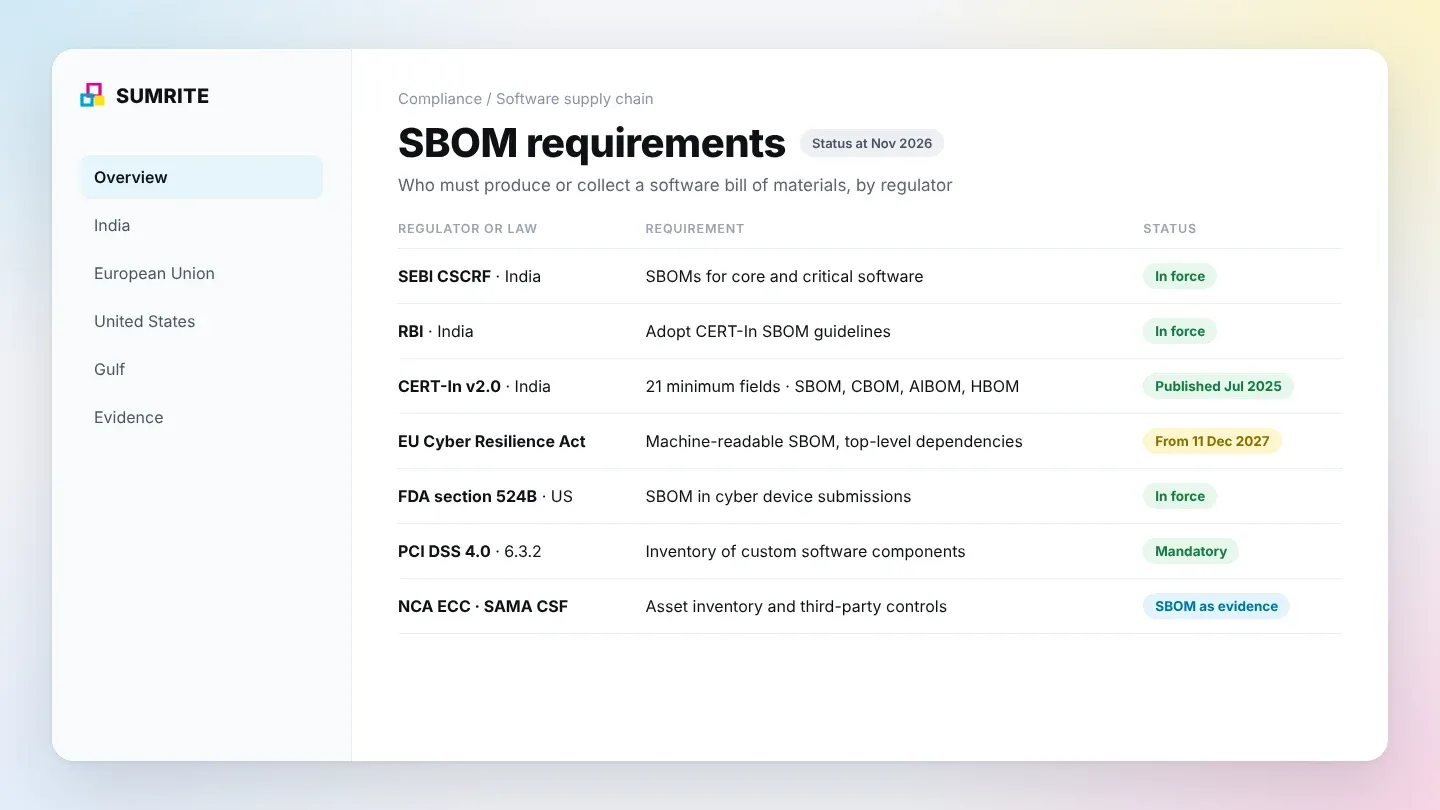
SBOM requirements at a glance
| Regulator or law | Region | Who it applies to | What it requires | Status |
|---|---|---|---|---|
| SEBI CSCRF | India | SEBI-regulated entities | SBOMs for core and critical software, in-house and third-party | In force |
| RBI | India | Banks, NBFCs and other regulated entities | Adopt CERT-In SBOM guidelines | In force |
| CERT-In v2.0 | India | Government, public sector, essential services, their suppliers | SBOM with 21 minimum fields, plus QBOM, CBOM, AIBOM and HBOM guidance | Published 9 July 2025 |
| EU Cyber Resilience Act | EU | Manufacturers of products with digital elements | Machine-readable SBOM, at least top-level dependencies | From 11 December 2027 |
| FDA section 524B | US | Manufacturers of cyber devices | SBOM in premarket submissions | In force since 2023 |
| CISA 2026 Minimum Elements | US and partners | All software, as baseline guidance | Minimum fields and practices | Published July 2026 |
| PCI DSS 4.0 req. 6.3.2 | Global | Entities in PCI DSS scope | Inventory of custom software and its third-party components | Mandatory since 31 March 2025 |
| NCA ECC, SAMA CSF | Saudi Arabia | Government, critical sectors, financial institutions | Asset inventory, trusted sources, third-party controls | No explicit SBOM; evidence |
India: CERT-In, SEBI and RBI
India has moved further than most countries on SBOMs, and three bodies are involved.
CERT-In Technical Guidelines (v2.0, July 2025)
CERT-In published its first Technical Guidelines on Software Bill of Materials on 3 October 2024 and expanded them on 9 July 2025 into version 2.0, covering five bills of materials: SBOM, QBOM and CBOM (quantum and cryptographic), AIBOM (AI systems) and HBOM (hardware). The guidelines target government, public sector and essential services organisations and the developers and integrators who supply them.
The SBOM section sets 21 minimum data fields, more than the CISA baseline. Beyond name, version and supplier, CERT-In expects fields such as:
- Component description and origin (open source or proprietary)
- Licence and any usage restrictions
- Dependencies and a unique identifier for each component
- Checksums or hashes for integrity
- Criticality of the component to the product
- Known vulnerabilities and patch status
- Release date and end-of-life date
- Author of the SBOM data and timestamp
The guidelines recommend SPDX or CycloneDX, a new SBOM for every version, pairing SBOMs with VEX, and secure, access-controlled storage with history. They also expect a named owner for SBOM management. If an Indian buyer asks for a “CERT-In compliant SBOM”, this field list is what they will check.
SEBI CSCRF
SEBI’s Cybersecurity and Cyber Resilience Framework (CSCRF), issued in August 2024, makes SBOMs part of supply chain security for regulated entities: stock brokers, depositories and their participants, mutual funds, portfolio managers, market infrastructure institutions and other intermediaries.
In practice, regulated entities must obtain SBOMs for new core and critical software at the time of purchase, and maintain them for existing critical systems. SEBI’s April 2025 clarifications confirmed the scope covers in-house, third-party, legacy and SaaS applications used for SEBI-regulated activities. SBOMs must be updated whenever the software changes, and auditors check them during the CSCRF cyber audit. For the testing side of CSCRF, see our guide to SEBI CSCRF VAPT requirements.
RBI
RBI has not written its own SBOM field list. Instead, it advised regulated entities to adopt the CERT-In SBOM guidelines (RBI advisory, November 2024). For banks, NBFCs and other RBI-regulated entities, the CERT-In 21-field list is therefore the working standard, alongside existing RBI VAPT requirements.
Where Indian regulated entities struggle
The hard part is not your own code. It is the core banking, trading and payment software you buy. Many vendors still deliver incomplete SBOMs, or none. Sumrite reviews supplier SBOMs against the CERT-In field list, generates analyzed SBOMs from binaries where the vendor cannot, and maps the result to your CSCRF or RBI audit evidence.
European Union: the Cyber Resilience Act
The Cyber Resilience Act (Regulation (EU) 2024/2847) applies to almost every hardware and software product with digital elements placed on the EU market, wherever the manufacturer is based. That includes Indian and Gulf companies selling software or devices into Europe.
What it requires. Annex I, Part II, point 1 requires manufacturers to identify and document vulnerabilities and components, including by drawing up an SBOM in a commonly used, machine-readable format covering at the very least the top-level dependencies of the product.
When. The SBOM duty applies with the rest of Annex I from 11 December 2027. But the CRA’s duty to report actively exploited vulnerabilities to ENISA and the national CSIRT within 24 hours has applied since 11 September 2026, and you cannot meet that deadline without knowing what is inside your product. In practice, the SBOM is needed now.
Publishing. You do not have to publish the SBOM. It sits in the technical documentation and must be provided to market surveillance authorities on request. Germany’s BSI technical guideline TR-03183-2 is a useful reference for format and content detail. Our Cyber Resilience Act guide covers the wider obligations.
Top-level is the legal floor, not good practice
The CRA minimum is top-level dependencies, but most serious vulnerabilities sit deeper in the tree. Log4Shell was typically a transitive dependency. Build your SBOM process for the full tree, and use the top-level rule only as the minimum you must not drop below.
United States: FDA, CISA and federal buyers
FDA section 524B. Since 29 March 2023, manufacturers of cyber devices, meaning medical devices that include software, can connect to the internet and could be vulnerable to cybersecurity threats, must include an SBOM in premarket submissions, covering commercial, open-source and off-the-shelf components. Since 1 October 2023 the FDA can refuse to accept submissions that lack the required cybersecurity information. The FDA expects machine-readable SBOMs alongside support level and end-of-support information for each component.
CISA 2026 Minimum Elements. On 29 July 2026, CISA, the NSA, the FBI and international partners published the 2026 Minimum Elements for a Software Bill of Materials, replacing the 2021 NTIA baseline. New elements include component hash, component licence, SBOM tool name and generation context. This is guidance, not law, but it is the baseline most buyers and regulators now point to. Separate guidance on SBOMs for AI systems was published with G7 partners in 2026.
Federal software buyers. Since Executive Order 14028 in 2021, US federal agencies have pushed suppliers towards secure development attestation and SBOMs, and agencies can request SBOMs from software producers.
PCI DSS 4.0: requirement 6.3.2
PCI DSS does not use the term SBOM. But requirement 6.3.2, mandatory since 31 March 2025, requires an inventory of bespoke and custom software, and third-party software components incorporated into bespoke and custom software, to support vulnerability and patch management. A Qualified Security Assessor will expect that inventory to be current and to drive patching decisions. An SBOM per application is the cleanest way to show both. See our guide to PCI DSS penetration testing requirements for the related testing duties.
Saudi Arabia and the UAE
Neither the NCA Essential Cybersecurity Controls (ECC-2:2024) nor the SAMA Cyber Security Framework names the SBOM. Both, however, require:
- An accurate, current inventory of information and technology assets
- Software development tools and libraries from trusted, licensed sources
- Vulnerability management across all assets, with defined remediation timelines
- Third parties held to the organisation’s cybersecurity requirements, with risk assessed during procurement
For software, an SBOM is the most direct evidence for all four. Saudi government entities, critical infrastructure operators and SAMA-regulated institutions increasingly ask vendors for an SBOM during procurement, and UAE banks and government buyers are following the same path. If you sell software into the Gulf, an SBOM and VEX file with your security pack removes a common delay. Our NCA ECC compliance guide and guide to what Saudi buyers ask SaaS vendors cover the rest of the checklist.
One SBOM process for every regulator
The requirements differ in detail, but you do not need a separate process for each. Build to the strictest field list you face, usually CERT-In, and every other requirement is covered.
- Generate a build or analyzed SBOM for every release in SPDX or CycloneDX, covering the full dependency tree, not just top-level components.
- Meet the CERT-In 21 fields and the CISA 2026 elements, including hashes, licences, tool name and generation context.
- Analyse every SBOM for vulnerabilities, licences and end-of-life components, and record decisions in VEX. Our SBOM analysis guide shows how.
- Collect and check supplier SBOMs at purchase and renewal, and make delivery a contract term.
- Store every version securely with history, so you can answer an auditor or a regulator about any past release.
- Name an owner and review the process at least once a year, as CERT-In and SEBI expect.
What auditors actually check
Across CERT-In, SEBI, PCI DSS and CRA reviews, auditors ask the same four questions. Does an SBOM exist for every in-scope product and version? Is it complete and in a standard format? Is it used to find and fix vulnerabilities, with evidence? Are supplier SBOMs collected and reviewed? A dated SBOM, an analysis report, VEX statements and a retest answer all four.
Sumrite’s SBOM analysis service produces exactly that evidence. We generate or validate SPDX and CycloneDX SBOMs for your applications, containers, firmware and supplier software, check them against the CERT-In and CISA field lists, rank and confirm exploitable vulnerabilities, issue VEX, and map the report to SEBI CSCRF, RBI, the EU Cyber Resilience Act, FDA 524B, PCI DSS, NCA ECC and SAMA CSF, with a retest included.
Sources: CERT-In Technical Guidelines on SBOM, QBOM and CBOM, AIBOM and HBOM v2.0 · SEBI CSCRF circular, August 2024 · Regulation (EU) 2024/2847, Cyber Resilience Act · FDA, Cybersecurity in Medical Devices · CISA, Software Bill of Materials · PCI Security Standards Council, PCI DSS v4.0.1
Frequently asked questions
Is an SBOM mandatory in India?
For many organisations, yes. SEBI's Cybersecurity and Cyber Resilience Framework (CSCRF) requires regulated entities to maintain SBOMs for core and critical software. RBI has advised its regulated entities to adopt CERT-In's SBOM guidelines. CERT-In's Technical Guidelines on SBOM, QBOM and CBOM, AIBOM and HBOM (version 2.0, 9 July 2025) apply to government, public sector and essential services organisations and are widely used as the baseline by others.
How many data fields do the CERT-In SBOM guidelines require?
CERT-In's guidelines list 21 minimum data fields for an SBOM, including component name, version, supplier, description, licence, origin, dependencies, unique identifier, checksums or hashes, criticality, vulnerabilities, patch status, release date and end-of-life date, plus the author and timestamp of the SBOM.
When does the EU Cyber Resilience Act require an SBOM?
The SBOM duty sits in Annex I, Part II of the Cyber Resilience Act (Regulation (EU) 2024/2847) and applies from 11 December 2027. Manufacturers must draw up an SBOM in a commonly used, machine-readable format covering at least the top-level dependencies of the product. Reporting of actively exploited vulnerabilities already applies from 11 September 2026.
Do I have to publish my SBOM under the CRA?
No. The SBOM is part of the technical documentation and must be made available to market surveillance authorities on request. Manufacturers may choose to share it with users, and if they do, the user information must say where it can be accessed.
Does the FDA require an SBOM for medical devices?
Yes, for cyber devices. Section 524B of the Federal Food, Drug, and Cosmetic Act requires manufacturers to include an SBOM covering commercial, open-source and off-the-shelf software components in premarket submissions for devices that include software, can connect to the internet and could be vulnerable to cybersecurity threats.
Does PCI DSS require an SBOM?
Not by name. PCI DSS 4.0 requirement 6.3.2, mandatory since 31 March 2025, requires an inventory of bespoke and custom software and the third-party software components incorporated into it. An SBOM is the most practical way to meet and evidence that requirement.
Do Saudi NCA or SAMA rules require an SBOM?
Neither NCA ECC nor SAMA CSF uses the term SBOM. Both require asset inventories, trusted software sources, vulnerability management and third-party security controls, and an SBOM is the most direct evidence for those controls in software. Saudi government and financial sector buyers increasingly ask vendors for one.