On this page
- Which Saudi security rules apply when you sell SaaS into Saudi Arabia?
- What does NCA ECC 4-1 require from third-party suppliers?
- Does NCA CCC apply to a SaaS company?
- How does the Saudi PDPL affect a foreign SaaS vendor?
- What penetration testing evidence will Saudi buyers ask for?
- What does a Saudi vendor security questionnaire ask?
- How should a SaaS vendor prepare before entering Saudi Arabia?
- How Sumrite helps
- Frequently asked questions
Western and European SaaS companies often arrive in Saudi Arabia with SOC 2 or ISO 27001 and expect that to close the security review. It helps, but it is rarely enough. Saudi buyers answer to Saudi regulators, so their questionnaires ask about Saudi controls, Saudi data handling and, increasingly, where your people and systems sit.
This guide, current as of November 2026, sets out what Saudi buyers will ask for, where each requirement comes from and how to build an evidence pack that gets you through procurement.
Which Saudi security rules apply when you sell SaaS into Saudi Arabia?
The rules that apply depend mainly on who your buyer is. A foreign SaaS vendor is rarely regulated directly by the NCA; instead, Saudi buyers pass their own obligations down to you through contracts, questionnaires and audits.
| Your Saudi buyer | Framework they flow down | What it means for you |
|---|---|---|
| Government entity or CNI operator | NCA ECC-2:2024, especially ECC 4-1 | Contract clauses, risk assessment, policy alignment |
| Government or CNI buyer using your cloud service | NCA CCC-2:2024 | You become a cloud service provider with your own control set |
| Bank, insurer or finance company | SAMA Cyber Security Framework, domain 3.4 Third Party Cyber Security | Vendor, outsourcing and cloud assurance |
| Any organisation handling personal data | PDPL and SDAIA regulations | Processor duties, transfers, breach support |
| Other private companies | NCA’s Non-CNI Private Sector Entities Cybersecurity Controls (NCNICC-1:2025), per Al Tamimi & Company | Lighter baseline, but buyers still ask for evidence |
Two further checks are worth making early. If your product is itself a cybersecurity product or service, the NCA states on its registration and licensing page that registration is mandatory for entities offering cybersecurity products, solutions or services in the Kingdom, a requirement since 1 August 2022. And if you plan to host in Saudi Arabia, the Communications, Space and Technology Commission (CST) runs a cloud computing services provider registration with classes A to C; confirm with local counsel whether it applies to your model.
For the full NCA picture, read our NCA ECC compliance guide, and for financial buyers our SAMA Cyber Security Framework guide.
What does NCA ECC 4-1 require from third-party suppliers?
NCA ECC 4-1 (Third-Party Cybersecurity) requires Saudi entities to define cybersecurity requirements for supplier contracts and enforce them. For a SaaS vendor that means contract clauses on confidentiality and data deletion, incident communication, and a duty to follow the buyer’s cybersecurity policies and Saudi law.
We checked the numbering against the ECC-2:2024 document: ECC 4-1 is the Third-Party Cybersecurity subdomain inside Domain 4, Third-Party and Cloud Computing Cybersecurity, and ECC 4-2 covers cloud computing and hosting.
- ECC 4-1-1
- Cybersecurity requirements for third-party contracts and agreements are identified, documented and approved
- ECC 4-1-2-1
- Non-disclosure clauses and secure removal of the entity's data when the service ends
- ECC 4-1-2-2
- Communication procedures for cybersecurity incidents
- ECC 4-1-2-3
- The third party must follow the entity's cybersecurity requirements, policies and applicable laws
- ECC 4-1-3-1
- For outsourced IT, cybersecurity and managed services: a risk assessment before contracting
- ECC 4-1-3-2
- Managed service centres that monitor or operate through remote access must be located fully inside Saudi Arabia
- ECC 4-1-4
- Periodic review of third-party cybersecurity requirements
ECC 4-1-3-2 is the clause that surprises foreign vendors most. If your offering includes monitoring or operating the customer’s environment over remote access, such as managed detection, managed administration or a support team with standing access, expect the buyer to ask where that service centre sits. A pure multi-tenant SaaS product is a different model from a managed service, so document clearly which one you provide.
ECC 4-1-2-3 also means your incident process must fit theirs. Buyers will want named contacts, notification timelines and evidence that you will cooperate with their response. Our NCA ECC checklist lists every Domain 4 control a buyer will test you against.
Does NCA CCC apply to a SaaS company?
NCA CCC-2:2024 applies to a SaaS company when it provides cloud services to in-scope tenants: Saudi government entities (inside or outside the Kingdom), their companies and sub-entities, and private organisations that own, operate or host critical national infrastructure (CNI). In that case the SaaS company is a cloud service provider (CSP) under CCC and must meet both ECC and CCC.
The CCC-2:2024 document sets out what that involves:
- Control volume. CSPs have 37 main controls and 94 subcontrols; tenants have 18 main controls and 26 subcontrols. Provider controls carry a “P” in the reference (for example 1-3-P-1-1) and tenant controls a “T”.
- Data classification levels. Controls are mandatory or optional across four levels that map to top secret, secret, confidential and public data. Where data sets mix levels, the highest level applies.
- Penetration testing. Subcontrol 2-10-P-1-1 requires penetration tests that cover the cloud technology stack at least once every six months.
- Saudi staffing. Subcontrol 1-4-P-1-1 requires cybersecurity roles in CSP data centres within the Kingdom to be filled by qualified Saudi nationals.
- Access approval. Subcontrol 2-2-P-1-9 requires CSPs and their third parties to obtain the tenant’s approval before accessing tenant-related assets.
- Data localisation. CCC-2:2024 moved data localisation controls to the National Data Management Office (NDMO), so hosting location questions now go through NDMO rules and your buyer’s data classification.
CCC does not cover CSPs that serve only non-Saudi entities outside the Kingdom, or only individuals and private non-CNI companies with no in-scope tenants. The NCA still strongly encourages other organisations to use CCC as best practice, so many private Saudi buyers use it as their questionnaire baseline anyway. Our guide to NCA CCC testing requirements explains the provider and tenant split in detail.
How does the Saudi PDPL affect a foreign SaaS vendor?
The Saudi PDPL applies to any processing of personal data of people residing in Saudi Arabia, including processing by parties outside the Kingdom. SDAIA’s guide for controllers and processors states that entities abroad remain parties to the processing, and that data hosted on a foreign cloud is still subject to the PDPL.
Most SaaS vendors act as processors. That puts four practical demands on you:
- Contractual compliance. SDAIA’s guide says a controller must ensure the processors it engages fully comply with the PDPL, so expect a data processing agreement and audit rights.
- Security safeguards. The guide requires adequate technical and organisational measures to protect confidentiality, integrity and availability in transit and in storage.
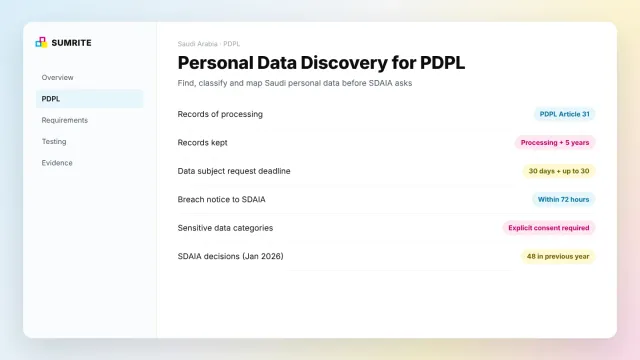
- Breach support. Under Article 24 of the Implementing Regulation, your customer must notify SDAIA within 72 hours of becoming aware of a qualifying breach, so your own notification to the customer has to be faster.
- Transfers outside the Kingdom. Hosting or support access from outside Saudi Arabia is a transfer. SDAIA’s Standard Contractual Clauses (version 1.0, September 2024) include controller-to-processor and processor-to-processor modules.
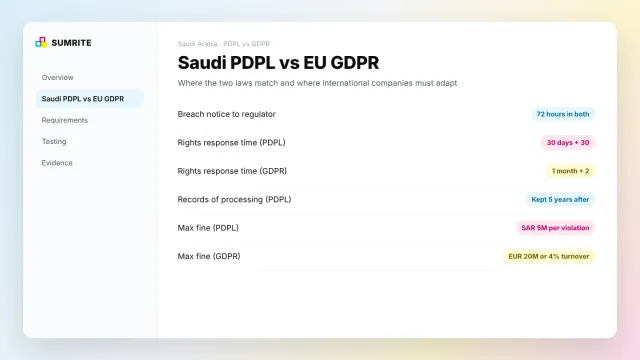
European vendors will recognise much of this from GDPR, but the details differ. Watch the draft amendments too: law-firm analysis of SDAIA’s October 2026 draft Implementing Regulation changes reports a proposed express duty to store personal data inside the Kingdom. Our Saudi PDPL compliance guide and analysis of the 2026 Implementing Regulation amendments cover both.
What penetration testing evidence will Saudi buyers ask for?
Saudi buyers expect a recent, manual penetration test of your SaaS application and APIs, with a report showing scope, method and findings by severity, plus retest proof that serious findings are closed. An automated scan output or a self-declaration will not satisfy a buyer that must evidence ECC 4-1 and its own ECC 2-11 testing programme.
- Penetration test report or executive summary recent enough for the buyer’s own testing cycle, and no older than six months if you are a CSP for in-scope CCC tenants
- Scope covering the production web application, APIs, authentication, tenant isolation and the cloud configuration behind them
- Manual testing against recognised methods such as the OWASP Top 10 and OWASP API Security Top 10
- Findings with severity ratings, affected assets and remediation status
- Retest evidence showing critical and high findings closed
- Tester details, including whether the testing firm can work under Saudi requirements
- A letter of attestation you can share under NDA without exposing full exploit detail
Tenant isolation deserves special attention. A Saudi government or CNI buyer will ask whether another customer could reach its data, and CCC expects CSPs to separate tenants. Test it directly with web application VAPT and API security testing, and check the cloud layer with a cloud security assessment.
Our pillar guide to penetration testing in Saudi Arabia explains how ECC 2-11 and SAMA testing work, and the sample VAPT report shows the level of detail buyers expect.
What does a Saudi vendor security questionnaire ask?
A Saudi vendor security questionnaire asks the same core questions as a European one, plus Saudi-specific questions on data location, staff access, incident timelines and NCA control mapping. Prepare a reusable answer and evidence for each.
| Question you will be asked | Evidence that closes it |
|---|---|
| Where is customer data stored and processed? | Data flow diagram, hosting regions, sub-processor list |
| Who can access our data, and from where? | Access model, support locations, approval workflow |
| How will you notify us of an incident? | Incident response plan with contacts and timelines |
| Do you meet NCA ECC 4-1 contract requirements? | Contract clause mapping to ECC 4-1-2 |
| Are you a CSP under NCA CCC? | Service model statement and CCC control mapping if in scope |
| How do you protect personal data under the PDPL? | DPA, transfer mechanism, security measures summary |
| When was your last penetration test? | Report or summary, plus retest evidence |
| What certifications do you hold? | ISO 27001 certificate or SOC 2 report, mapped to ECC |
ISO 27001 covers much of what ECC asks, and a mapping saves you from answering each control from scratch; see our ISO 27001 to NCA ECC mapping. Our vendor risk and TPRM page explains how buyers tier vendors and what they expect in an evidence pack.
How should a SaaS vendor prepare before entering Saudi Arabia?
Prepare before the first tender: map your controls to ECC and CCC, settle your data residency and transfer position, and commission a penetration test that covers what Saudi buyers will ask about. Vendors who arrive with an evidence pack move through procurement far faster than those who start when the questionnaire lands.
- Classify your target buyers. Government and CNI, financial sector, or other private companies. This tells you whether ECC, CCC or SAMA CSF will be flowed down.
- Decide your service model. Pure SaaS, SaaS with managed services, or on-premises. Remote-access managed services trigger ECC 4-1-3-2.
- Map your controls. Map ISO 27001 or SOC 2 controls to ECC Domain 4 and, if relevant, to the CCC provider controls.
- Settle data residency and transfers. Decide whether you will host in-Kingdom, and prepare SDAIA Standard Contractual Clauses and a transfer risk assessment for any data leaving Saudi Arabia.
- Commission a penetration test. Cover the application, APIs, tenant isolation and cloud configuration, and include a retest. Add source code review for high-assurance buyers.
- Build the evidence pack. Policies, incident plan, sub-processor list, control mappings, certifications and the pentest summary in one place.
- Keep it current. Retest after major releases. Continuous penetration testing keeps evidence fresh between annual tests.
If you are weighing the threat side of the market, our overview of cyber attacks in Saudi Arabia in 2026 shows what Saudi security teams are defending against, which shapes the questions they ask you.
How Sumrite helps
Sumrite runs penetration testing and compliance programmes for SaaS vendors entering Saudi Arabia end to end with our verified NCA-registered partner firm, and has served 100+ Saudi clients across Riyadh, Jeddah, Dammam and other cities. We test your application, APIs, tenant isolation and cloud configuration manually, map findings to ECC and CCC control numbers, retest your fixes and help you assemble an evidence pack for Saudi questionnaires. Our Saudi Arabia page explains how to get a Sumrite VAPT report for Saudi reviews in 48 hours.
Get your Saudi evidence pack ready before the questionnaire arrives
Tell us who your Saudi buyers are and how your product is hosted, and we will scope the testing and control mapping they will ask for. Book a scoping call.
Frequently asked questions
What security requirements apply to a foreign SaaS vendor selling to Saudi Arabia?
A foreign SaaS vendor selling to Saudi Arabia usually meets Saudi requirements through its customers' contracts rather than directly. Government and critical national infrastructure buyers flow down the NCA Essential Cybersecurity Controls (ECC-2:2024) third-party controls in ECC 4-1 and, for cloud services, the NCA Cloud Cybersecurity Controls (CCC-2:2024), while the Personal Data Protection Law (PDPL) applies whenever the vendor processes personal data of people in the Kingdom.
What does NCA ECC 4-1 require from third-party suppliers?
NCA ECC 4-1 requires the Saudi entity to define cybersecurity requirements for third-party contracts, including non-disclosure and secure data removal at the end of the service, incident communication procedures, and an obligation for the supplier to follow the entity's cybersecurity policies and applicable laws. For outsourced IT, cybersecurity and managed services, ECC 4-1-3 adds a pre-contract risk assessment and requires remote-access monitoring and operations centres to be located fully inside Saudi Arabia.
Does NCA CCC apply to a SaaS company?
NCA CCC-2:2024 applies to a SaaS company when it provides cloud services to in-scope tenants, meaning Saudi government entities and private organisations that own, operate or host critical national infrastructure. In that case the SaaS company is a cloud service provider under CCC, with 37 main controls and 94 subcontrols, including penetration tests of the cloud technology stack at least once every six months.
Does the Saudi PDPL apply to SaaS vendors based outside Saudi Arabia?
The Saudi PDPL applies to processing of personal data of individuals residing in the Kingdom, including processing by parties outside Saudi Arabia, according to SDAIA's guide for controllers and processors. A foreign SaaS vendor usually acts as a processor, so its Saudi customer must ensure it complies, and transfers outside the Kingdom must follow SDAIA's transfer rules, such as its Standard Contractual Clauses.
What penetration testing evidence do Saudi buyers expect from SaaS vendors?
Saudi buyers typically expect a recent manual penetration test of the SaaS application and its APIs, a summary or report showing scope, methodology and findings by severity, and retest evidence that critical and high findings are closed. Buyers covered by NCA ECC must test periodically under ECC 2-11, and CCC requires cloud service providers serving in-scope tenants to test the cloud technology stack at least every six months.
Faisal Khan is a Director at Sumrite, where he oversees penetration testing, risk assessment and compliance engagements for SaaS and enterprise clients. Case studies are anonymised and published with client permission.