On this page
Why the hospital asked for both a test and an assessment
Hospitals in the Kingdom are measured against the National Cybersecurity Authority’s Essential Cybersecurity Controls and hold some of the most sensitive personal data there is, which brings the Saudi Personal Data Protection Law into every system that touches a patient record. This hospital already had regular NCA ECC audits, disaster-recovery exercises and threat intelligence in place. What it wanted was independent proof of two things: whether an attacker could actually break in, and whether the controls on paper were working in practice.
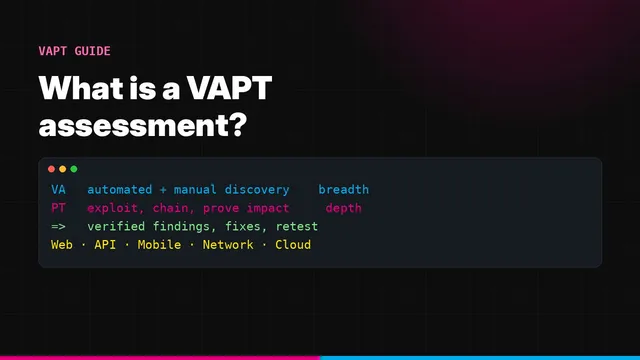
| Part | Question it answers | Method |
|---|---|---|
| Penetration testing | Can an attacker get in, and what can they reach? | Grey-box, manual testing with safe proof of exploitation |
| Risk assessment | Are the controls that should stop them in place and evidenced? | Control testing against documents, interviews and system evidence |
What we tested
- The patient e-services portal and the public website
- The Android patient app and the API behind it
- The internal network, through both a credentialed vulnerability assessment and a penetration test
- The core database server
- DDoS resilience of the public portal, with a bounded load test in an approved window
- Governance, identity, privileged access, vendors, network, email, detection and response, application security and operational technology, in the risk assessment
Testing followed the OWASP Web Security Testing Guide, OWASP MASVS and MASTG for mobile, and NIST SP 800-115 for infrastructure. Every risk-assessment control was mapped to NCA ECC, the PDPL, ISO/IEC 27001:2022 and CIS Controls v8.
The issues that mattered most
None of the most serious issues needed a zero-day. A storage bucket listed patient documents to anyone on the internet. Internal servers were open to flaws such as BlueKeep and EternalBlue that were patched years ago. The core database was well behind on vendor security updates. These are the problems attackers look for first, because they work.
Each area has its own write-up:
- Patient portal and website: an open storage bucket, unauthenticated uploads leading to stored XSS, and IDOR
- Internal network and database: unpatched remote code execution and a database behind on patches
- Android app and DDoS resilience: a debuggable production build and no rate limiting in front of the portal
- Cybersecurity risk assessment: why privileged access and vendor risk came first
How a long list became a short one
A long list of findings does not get fixed. A short list in the right order does. We ranked by three questions:
- Is it reachable from the internet? Internet-facing systems went first.
- Does it expose patient data? Systems holding health records ranked above everything else at the same severity.
- Can it be exploited without a login? Unauthenticated, remote flaws beat those that need an existing foothold.
The result was a focused Priority 1 list for immediate action, with the remaining work following in severity order under named owners and dates.
Evidence, not assumptions
In the risk assessment, a control passed only when its implementation was demonstrated. Where evidence was incomplete or ambiguous, the control was rated as a gap. That is deliberately conservative, and it has a practical upside: controls that exist but were never evidenced can be closed quickly once the evidence is supplied.
In testing, no issue is closed until a retest proves the fix, using the same technique that reproduced it, with before-and-after evidence recorded. That is what an NCA ECC auditor expects to see.
What other Saudi hospitals can take from this
- Test the patient portal first. It is internet-facing, it holds health records, and here it carried some of the most serious issues.
- Patch management is the cheapest win. Most internal issues had public fixes available for years.
- Privileged access is the main route to full compromise. Evidence your PAM controls before an attacker tests them.
- An NCA ECC audit is not a penetration test. Passing audits and being hard to break into are different things.
Sumrite runs hospital and healthcare engagements end to end in Saudi Arabia and the UAE. See VAPT services in Saudi Arabia, or read this in Arabic.
Frequently asked questions
What does a hospital penetration test in Saudi Arabia cover?
A full hospital engagement usually covers the internet-facing patient portal and website, the mobile app, the internal network, core databases and the resilience of public services under load. It is often paired with a cybersecurity risk assessment mapped to NCA ECC and the Saudi PDPL.
What is the difference between VAPT and a cybersecurity risk assessment?
VAPT tests systems technically and proves which weaknesses can be exploited. A risk assessment checks whether controls such as privileged access, vendor management, monitoring and governance exist and can be evidenced. Hospitals need both: the test shows the open doors, the assessment shows why they stay open.
How should a hospital prioritise security findings?
By exposure, data sensitivity and ease of exploitation, not by count. Internet-facing systems handling patient data come first, then flaws that can be exploited remotely without a login, then everything else in severity order with named owners.
Is the hospital named in this case study?
No. Sumrite case studies are anonymised. Names, systems, locations, figures and anything that could identify the client are removed; only patterns that help other organisations are published.
Faisal Khan is a Director at Sumrite, where he oversees penetration testing, risk assessment and compliance engagements for SaaS and enterprise clients.