On this page
What drives the price
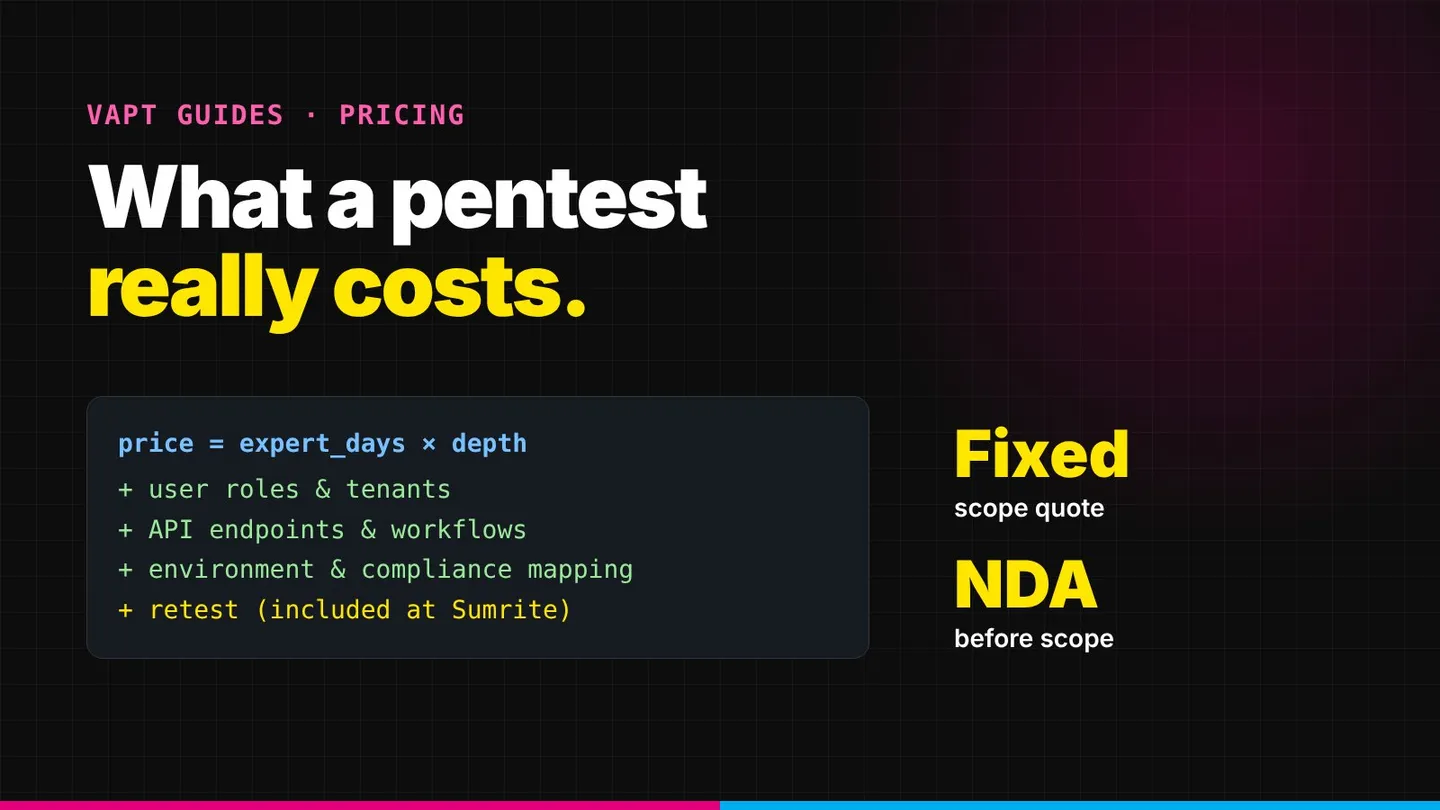
- Scope size
- Number of applications, pages, endpoints, hosts or cloud accounts.
- Roles and tenants
- Each role and tenant multiplies the authorisation tests.
- Depth
- Black, grey or white box; source code review adds effort.
- Environment
- Staging that mirrors production is quicker than a fragile setup.
- Platforms
- Mobile apps need static and dynamic analysis plus the backend.
- Retest
- Confirms fixes. Should be part of the quote.
- Urgency
- Short deadlines need scheduled capacity.
VAPT cost factors at a glance
| Factor | Lowers the effort | Raises the effort |
|---|---|---|
| Scope | One application or API | Several apps, APIs, hosts or cloud accounts |
| Roles and tenants | One or two user roles | Many roles and multi-tenant data |
| Testing depth | Black box, unauthenticated | Grey or white box, source code access |
| Environment | Stable staging that mirrors production | Fragile or production-only systems |
| Platforms | Web only | Web plus Android, iOS and backend APIs |
| Compliance mapping | Standard report | Mapping to several frameworks or a regulator format |
| Retest | Included in the quote | Charged separately |
What does VAPT testing cost? Published market figures
Sumrite quotes a fixed price after scoping, so it does not publish a price list. Public figures from other sources show how wide the market range is:
- Government tenders in India: a Qualysec analysis of CERT-In audit costs (November 2026) cites NICSI empanelment rates of ₹10.8 lakh, ₹13.5 lakh and ₹16.2 lakh per critical application (small, medium and large, excluding tax), alongside much smaller GeM bids for single portals.
- Platform-led pentests: Astra Security’s pricing page lists pentest plans starting at US$2,999 per pentest (November 2026).
Treat these as reference points, not quotes: the same application can cost very different amounts depending on how many expert testing days are included, whether testing is authenticated across every role, and whether a retest is part of the price. For how Sumrite builds a quote, see VAPT pricing at Sumrite.
How to compare quotes
- Is the scope written down, with assets, roles and environments?
- Is testing authenticated across every role and tenant?
- Who performs the test and what are their credentials?
- Is every finding verified, with evidence and reproduction steps?
- Is a retest included, with an updated report?
- Can you see a redacted sample report?
A very cheap quote is often a scan-only product. Read what makes a VAPT report worth paying for and VAPT vs vulnerability scan.
Ways to spend less without losing quality
- Run the free scan at scan.sumrite.com and fix the scanner-level findings.
- Write a clear scope and prepare test accounts.
- Test staging that matches production.
- Combine frameworks into one test; see which frameworks require penetration testing.
- Plan the test before the deadline, not during it.
Get a fixed quote
Share your scope and we will return a fixed-scope quote, NDA first. Get a Quote.
Frequently asked questions
How much does a VAPT cost?
It depends on scope: the number and size of applications, APIs and hosts, the number of roles and tenants, depth of testing, environment and whether a retest is included. Ask for a fixed quote based on a written scope.
Why are some pentest quotes so cheap?
Very low prices usually mean a scanner export with a logo on it. Compare what each quote includes: authenticated testing, verification, evidence, remediation advice and a retest.
Is the retest included in the price?
It should be. Sumrite includes a retest of fixed findings, so you can show that issues are closed.
Can I reduce the cost of a pentest?
Yes. Fix scanner-level issues first using a free scan, give a clear scope, prepare test accounts and avoid scope changes during the test.
Faisal Khan is a Director at Sumrite, where he oversees penetration testing, risk assessment and compliance engagements for SaaS and enterprise clients.