On this page
- Why does NCA registration come first when choosing a penetration testing company?
- What should a penetration testing company in Saudi Arabia include in its proposal?
- What is the 12-point checklist for comparing penetration testing vendors in Saudi Arabia?
- Which questions should you ask a penetration testing vendor before you sign?
- What are the red flags when choosing a penetration testing company in Saudi Arabia?
- How do cost and timelines fit into choosing a penetration testing company?
- Does it matter whether the company is in Riyadh, Jeddah or Dammam?
- How Sumrite helps
- Frequently asked questions
Delivered with a verified NCA-registered partner
Sumrite runs VAPT for Saudi organisations end to end with our verified NCA-registered partner firm, and has served 100+ Saudi clients across Riyadh, Jeddah, Dammam and other cities. Talk to our team.
Search for penetration testing companies in Saudi Arabia and most results are “Top 10” lists written by one of the ten. They tell you who is selling, not who will satisfy an NCA assessor or a SAMA examiner. This guide gives you a checklist and a set of questions to apply to every vendor instead. For the regulations behind it, start with our pillar guide to penetration testing in Saudi Arabia.
Why does NCA registration come first when choosing a penetration testing company?
NCA registration comes first because NCA requires every entity providing cybersecurity services in Saudi Arabia to be registered, so an unregistered tester creates a compliance problem before any testing starts. NCA’s registration and licensing page states that registration on its digital platform has been a regulatory requirement since 1 August 2022.
Registration runs through Haseen, NCA’s National Cybersecurity Services Portal, and NCA publishes a list of registered service providers from the same page. Two practical checks follow:
- Ask for the registered entity name and look it up on NCA’s list. Marketing names and legal names often differ.
- Check who actually tests. If a foreign firm delivers through a Saudi partner, confirm the partner is the registered entity and that the contract says who performs the work.
Registration is a floor, not a quality signal. It tells you a firm may operate; it does not tell you how good the testing is. The rest of the checklist covers that.
What should a penetration testing company in Saudi Arabia include in its proposal?
A credible proposal names the regulatory controls it supports, lists the in-scope assets from your inventory, states the test perspective and method, and includes a retest window. If a proposal arrives before anyone has asked about your assets, it is pricing a scan, not a penetration test.
Regulatory mapping
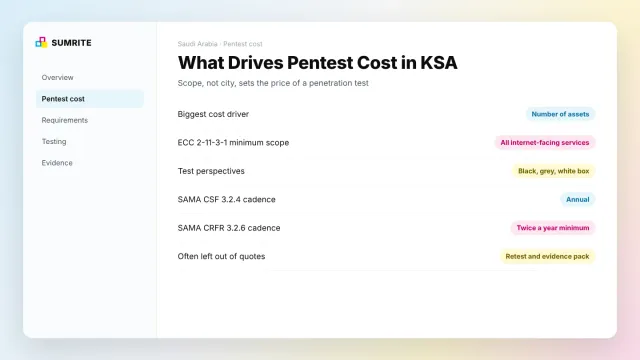
The NCA Essential Cybersecurity Controls (ECC-2:2024) require, in control 2-11-3-1, that the testing scope includes all internet-facing services and their technical components: infrastructure, websites, web applications, smartphone and tablet applications, email and remote access. SAMA-regulated firms also answer to SAMA CSF 3.2.4, which calls for annual review and penetration tests of customer and internet-facing services. A good proposal names these control numbers and shows which asset covers which component. Our deep dives on NCA ECC penetration testing requirements and SAMA penetration testing explain both.
Scope and method
- Asset-level scope: URLs, API collections, app builds, IP ranges, user roles.
- Perspective: black box, grey box or white box. NCA’s Penetration Testing Standard template expects the approach to be defined for each exercise. See black box vs grey box vs white box testing.
- Rules of engagement: the same NCA template requires a rules-of-engagement document before testing begins, covering scope, timing, tools and permissions.
What is the 12-point checklist for comparing penetration testing vendors in Saudi Arabia?
Score every vendor against the same twelve criteria: registration, regulatory mapping, scope, manual depth, people, delivery location, data handling, reporting, retest, evidence support, timelines and references. Use the checklist below as a scoring sheet; ask us for it as a spreadsheet via the contact form if you want a ready-made version.
- NCA registration of the entity that performs the testing, checked on NCA’s published list.
- Control mapping to ECC 2-11 (and 2-10 where scanning is included), SAMA CSF 3.2.4, or CSCC for critical systems.
- Scope built from your asset inventory, covering every 2-11-3-1 component, not a generic “website plus network” bundle.
- Manual, expert-led depth, with a stated approach to business logic and access control.
- Named testers with CVs and relevant certifications available for your file.
- Delivery location and access agreed in writing, including where testing traffic originates.
- Data handling: how screenshots, credentials and findings are stored, encrypted and destroyed.
- Reporting with an executive summary, severity ratings, reproduction steps and remediation advice, in Arabic and English if your board needs it.
- Retest included within a defined window.
- Evidence support for NCA, SAMA or SDAIA reviews.
- Realistic timelines that leave room for remediation before your audit date.
- References from organisations in a similar sector and regulatory position.
Which questions should you ask a penetration testing vendor before you sign?
Ask questions that force specific answers: who tests, how much is manual, how findings map to Saudi controls, and what happens after the report. Vague answers to these questions are the clearest warning sign in vendor selection.
| Area | Question to ask | A good answer sounds like |
|---|---|---|
| Registration | Which legal entity is NCA-registered, and does it perform the test? | A named entity you can find on NCA’s list |
| People | Who are the named testers and what have they tested before? | Names, CVs, relevant experience |
| Method | What share of effort is manual? | Most of it, with tools used for coverage |
| Mapping | How will findings map to ECC 2-11 and SAMA CSF 3.2.4? | A sample report showing control references |
| Scope | Which 2-11-3-1 components are covered? | Each one listed against your assets |
| Data | Where is test data stored and when is it deleted? | A written process and a deletion date |
| Retest | Is a retest included, and within what window? | Yes, with a defined period |
| Output | Can we see a redacted sample report? | Yes, immediately |
A few more questions are worth adding for regulated buyers:
- For banks and fintechs: how will production testing be coordinated with our SOC, and what are the stop conditions?
- For government entities and CNI operators: will the contract carry the cybersecurity clauses that ECC 4-1 expects for third parties, such as a risk assessment before signing?
- For organisations holding personal data: how will the vendor handle personal data it sees during testing under the PDPL? Our Saudi PDPL compliance guide covers the obligations.
To judge reports, compare each vendor’s sample with our sample VAPT report and the criteria in what makes a VAPT report worth paying for.
What are the red flags when choosing a penetration testing company in Saudi Arabia?
The main red flags are a fixed price before scoping, no named testers, scanner output presented as a penetration test, no retest, and no way to verify NCA registration. Any one of them should pause the decision.
A warning sign
A quote for “full VAPT” that arrives before anyone has asked about your assets. That is a scan, priced as a pentest.
Other signals to watch:
- Reports that list CVEs but no business-logic findings. That usually means no manual testing. Our guide to vulnerability assessment vs penetration testing explains why NCA treats them as separate controls.
- “Certified ECC compliant” claims. ECC is a set of controls assessed by NCA; there is no ECC certificate for a vendor to issue.
- No change-driven testing option. If you release often, ask about continuous penetration testing.
How do cost and timelines fit into choosing a penetration testing company?
Cost should be the last filter, applied only to vendors that pass the checklist, and compared on identical scope. Price depends on the number and complexity of assets, test depth, delivery constraints, reporting language and whether retesting is included, not on the city.
We cover each cost driver, and how to write a scope that gets comparable quotes, in our guide to penetration testing cost in Saudi Arabia. Timeline matters just as much: a single web application usually needs one to two weeks of testing plus reporting, and you should leave time for fixes and a retest before an assessment date. Our general guide on how long a penetration test takes has more detail.
Does it matter whether the company is in Riyadh, Jeddah or Dammam?
What matters is whether the provider can put engineers on site in your city, alongside registration and quality. External tests can run on site or remotely, but internal networks, critical systems and operational technology often need testers on site or testing traffic from inside Saudi Arabia, and many Saudi buyers prefer to meet the engineers doing the work.
- Riyadh: government-linked entities and financial institutions often have strict access rules. See penetration testing in Riyadh.
- Eastern Province (Dammam, Jubail): industrial and OT environments need on-site safety coordination.
- Jeddah: retail, logistics and port operations often need testing coordinated across many sites.
How Sumrite helps
Sumrite runs penetration testing end to end with our verified NCA-registered partner firm, and has served 100+ Saudi clients across Riyadh, Jeddah, Dammam and other cities. We scope from your asset inventory, test manually across web applications, mobile apps, APIs and networks, map every finding to ECC 2-11 or SAMA CSF 3.2.4, run a remediation workshop and a retest, and hand you the evidence pack. Our Saudi Arabia page explains how we deliver a VAPT report ready for Saudi reviews in 48 hours. Run our free external scan first if you want a quick view of your internet-facing assets.
Put us through the checklist
Send us your asset list and ask us every question in this guide. We will answer in writing and return a scope mapped to your regulator. Book a scoping call.
Frequently asked questions
How do I choose a penetration testing company in Saudi Arabia?
A Saudi buyer should choose a penetration testing company whose testing entity is registered with the National Cybersecurity Authority (NCA), that scopes from the asset inventory, tests manually, maps findings to NCA ECC 2-11 or SAMA CSF 3.2.4, and includes a retest. Asking for a sample report and named testers before signing separates real testing firms from scan resellers.
Does a penetration testing company in Saudi Arabia need NCA registration?
The National Cybersecurity Authority states that registration on its digital platform has been a regulatory requirement for entities providing cybersecurity services in Saudi Arabia since 1 August 2022. NCA publishes a list of registered service providers, so a buyer can check the registered entity name of the firm, or delivery partner, that performs the test.
What questions should I ask a penetration testing vendor in Saudi Arabia?
Ask a Saudi penetration testing vendor which entity is NCA-registered, who the named testers are, how much of the effort is manual, how findings map to ECC 2-11 and SAMA CSF 3.2.4, how test data is stored and destroyed, and whether a retest is included. Ask for a redacted sample report to judge quality.
Are 'Top 10 penetration testing companies in Saudi Arabia' lists reliable?
Most 'Top 10 penetration testing companies in Saudi Arabia' lists are published by vendors that rank themselves first. A buyer gets a more reliable shortlist by applying the same written checklist to every vendor, checking NCA registration, and comparing redacted sample reports side by side.
How long does a penetration test take in Saudi Arabia?
A penetration test of a single web application in Saudi Arabia usually takes one to two weeks of testing plus reporting, and multi-asset scopes take longer. Buyers should also allow time for remediation and a retest, because NCA and SAMA reviewers look for evidence that findings were closed.
Faisal Khan is a Director at Sumrite, where he oversees penetration testing, risk assessment and compliance engagements for SaaS and enterprise clients.