On this page
Not sure how much to share with your pentester? Run the free scan at scan.sumrite.com for a first look, then talk to us about the right depth for your goal.
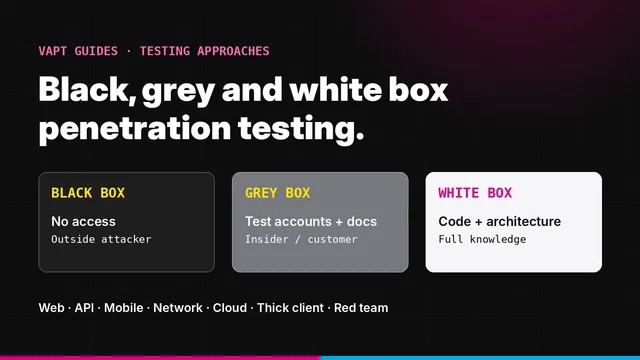
One of the first questions in scoping a penetration test is how much to tell the tester. Give them nothing and you get a realistic outsider’s view; give them everything and you get depth. The three labels, black, grey and white box, are just points on that scale, and picking the right one decides what your test actually finds.
The three approaches at a glance
| Black-box | Grey-box | White-box | |
|---|---|---|---|
| Information given | None beyond what is public | Partial: credentials per role, some docs | Full: source code, architecture, config, all credentials |
| Attacker simulated | External outsider, no access | Logged-in user, or outsider after reconnaissance | Insider with full knowledge, or a thorough review |
| Strength | Realism of the outsider view | Balance of realism and coverage | Depth and completeness |
| Weakness | May miss areas not reached in time | Not fully exhaustive | Less realistic as an “attack”; needs more access |
| Best for | Perimeter, phishing-style, realism tests | Most web apps and APIs | High-assurance systems, compliance, code review |
Black-box: the realistic outsider
In a black-box test, the tester knows only what any attacker on the internet could find. They discover your systems, map the attack surface and look for a way in from scratch. The appeal is realism: this is genuinely how an opportunistic external attacker begins, and it tests your perimeter and your public footprint honestly.
The weakness is time. A real attacker has unlimited patience; a test has a fixed number of days. Hours spent on reconnaissance and trying to get an initial foothold are hours not spent testing the application’s deeper functionality. If the tester never gets past the login page, the authenticated areas, often where the serious flaws live, go untested. Black-box can leave you reassured about the wrong thing.
White-box: maximum depth
A white-box test gives the tester everything: source code, architecture diagrams, configuration and credentials for every role. With full visibility they can trace every code path, reason about every input, and find issues that are almost impossible to see from outside, such as a flaw buried in a rarely used function or a subtle authorisation gap. It often pairs with source code review.
White-box gives the most complete coverage, which is why it suits high-assurance systems, regulated environments and anything where “we tested thoroughly” has to be true rather than hopeful. The trade-offs are that it needs more cooperation and access, and that it is less a simulation of an external attack than a deep inspection. For many systems, that depth is exactly the point.
More information is not cheating
A common worry is that giving credentials or code “makes it too easy” and hides how a real attacker would struggle. But your limited testing budget is better spent finding real flaws than watching a tester rediscover your architecture. Giving information simply models an attacker who has already done that homework, which many real attackers have.
Grey-box: the practical middle
Grey-box testing gives the tester partial information, most importantly valid credentials for each user role, plus some documentation about how the system works. It is the most common choice for web applications and APIs, and for good reason. It reflects the realistic and dangerous case of an authenticated user, or an attacker who has obtained an account, and it lets the tester get straight into the areas that matter rather than burning time at the perimeter.
With accounts for different roles, a grey-box test can properly check access control between users and between privilege levels, which is where some of the most serious findings live. It is the approach that usually gives the best coverage for the budget, which is why Summit uses it as the default for most application engagements.
How to choose
- Start from the goal. Realism of the outside view, deepest possible coverage, or a balance?
- Match the approach. Black-box for perimeter and realism tests; grey-box for most web and API work; white-box for high-assurance systems and code review.
- Consider compliance. Some frameworks or customers expect authenticated or code-level testing; let that steer you toward grey or white box.
- Mix where it helps. A black-box pass on the perimeter plus grey-box on the application is a common, effective combination.
- Always provide roles for access-control testing. If access control matters, the tester needs accounts at each level, which means at least grey-box.
This choice is separate from, and complementary to, the internal vs external decision and the broader types of penetration testing. One describes how much the tester knows; the other describes where they stand.
How Summit helps
Summit scopes each engagement around your goal rather than a fixed recipe. Most web application and API tests run grey-box with credentials for every role, so access-control and business-logic flaws surface; network tests combine black-box perimeter work with authenticated depth; and source code review brings white-box completeness where assurance demands it. Every engagement is manual, evidence-led and retested. Start with the free check at scan.sumrite.com.
Get the testing depth your goal needs
Tell us what you are testing and why. We will recommend the right level of access and scope for it. Get a quote or run the free scan first.
Related reading: Internal vs external penetration testing · Types of penetration testing · VAPT vs a vulnerability scan
Frequently asked questions
What is black-box penetration testing?
Testing with no inside information. The tester starts like an external attacker with nothing but what is public, discovering the target as they go. It is realistic for an outsider's view but can miss areas the tester never reaches in the time available.
What is white-box penetration testing?
Testing with full information: source code, architecture, credentials for all roles and configuration. It gives the deepest coverage because the tester can see every path, and often includes source code review. It needs more cooperation and access.
What is grey-box penetration testing?
Testing with partial information, typically valid credentials for each user role and some documentation. It balances realism and coverage and is the most common choice for web applications and APIs, because it reflects a logged-in user and reaches the authenticated areas efficiently.
Which approach is best?
For most web and API tests, grey-box gives the best coverage for the budget. White-box suits high-assurance or compliance-critical systems and code reviews. Black-box suits perimeter and phishing-style assessments where realism matters more than completeness.
Does more information make the test less realistic?
It changes which attacker you simulate, not the quality. Giving credentials and docs reflects an attacker who has done reconnaissance or already has a foothold, and it means the limited testing time is spent finding flaws rather than rediscovering what you already know.
How do I choose for my system?
Run Summit's free scan at scan.sumrite.com for a first look, then talk to us about the right level of access for your goal, whether that is realism, coverage or compliance.
Faisal Khan is a Director at Summit, where he oversees penetration testing, risk assessment and compliance engagements for SaaS and enterprise clients. Case studies are anonymised and published with client permission.