On this page
The core difference
A traditional penetration test answers “was this version secure in March?”. PTaaS answers “is what we ship secure now?”. The testing skill is the same. What changes is cadence, where findings live and how fixes are closed.
Side by side
- Cadence
- Traditional: annual or twice a year. PTaaS: release-based testing plus full tests on a cycle.
- Time to first finding
- Traditional: the end of the engagement, in a PDF. PTaaS: as soon as a tester verifies it, in a live platform.
- Developer handoff
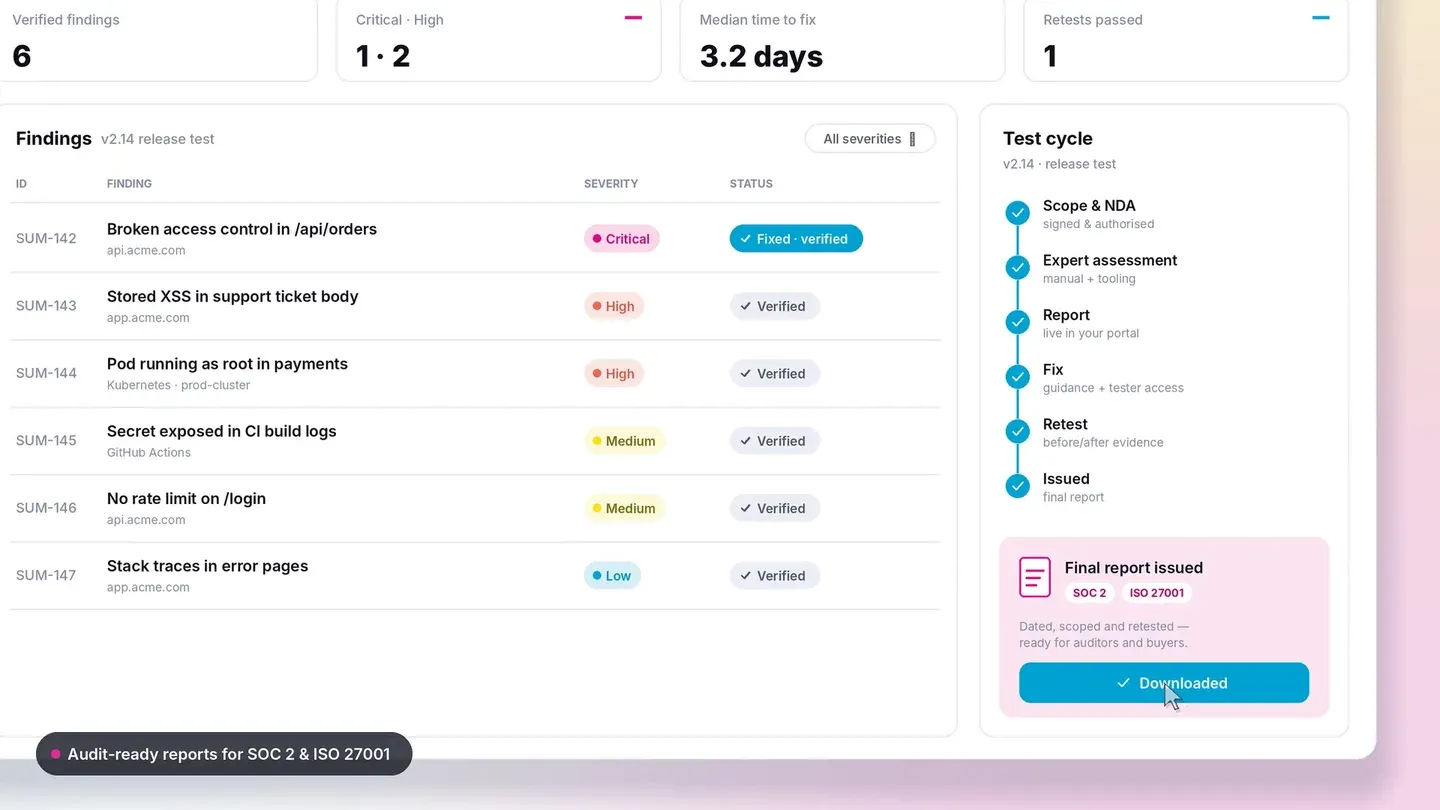
- Traditional: copy and paste into tickets. PTaaS: one-click Jira or GitHub tickets with evidence and fix guidance.
- Retests
- Traditional: often charged separately or skipped. PTaaS: requested per finding, closed only when verified.
- Compliance evidence
- Traditional: one report per year. PTaaS: a dated report for every cycle, ready for SOC 2 and ISO 27001.
- Scope changes
- Traditional: a new contract. PTaaS: add a release, API or cluster to the next cycle.
Where traditional pentesting falls short for fast teams
Reports age fast
Ship weekly and the report describes a product that no longer exists by the time it arrives. New endpoints and roles go live untested.
Findings get lost
A PDF does not assign owners. Issues sit between the report and the backlog until the next test finds them again.
Fixes are trusted, not proven
Without a retest built in, "fixed" often means "a developer said so". Auditors and buyers want proof.
Every test starts from zero
New scoping, new NDAs, new onboarding each time. PTaaS sets this up once.
When each one is the right choice
- Choose PTaaS if you release to production weekly or monthly
- Choose PTaaS if buyers send security questionnaires throughout the year
- Choose PTaaS if you need continuous SOC 2, ISO 27001 or PCI DSS evidence
- Choose a point-in-time test for systems that rarely change, such as an internal network
- Choose a point-in-time test for a one-off pre-launch or pre-acquisition check
- Choose a red team engagement to test detection and response, not just vulnerabilities
Most growing companies end up with both: PTaaS for the product they ship, and periodic point-in-time tests for networks and stable systems. Read how often you should run a penetration test and what PTaaS is for the basics.
What to check in either option
Whichever you choose, the testing has to be done by people. Ask for a sample report, check that findings carry evidence and fix guidance, and make sure retests are included. The PTaaS platform features that matter covers what to look for in a platform.
See PTaaS in action
Watch the platform walkthrough on the Sumrite continuous penetration testing page, or get a quote.
Frequently asked questions
What is the difference between PTaaS and traditional penetration testing?
Traditional penetration testing is a one-off project that ends in a PDF report. PTaaS delivers the same expert testing continuously through a platform, testing releases as they ship, publishing verified findings live, syncing them to Jira or GitHub and retesting fixes on request.
Is PTaaS more expensive than a traditional pentest?
It usually costs more than a single test but less than buying several separate tests a year, because scoping, NDAs and reporting are set up once. The price depends on how many applications are in scope and how often you release.
Do auditors accept PTaaS instead of an annual penetration test?
Yes, as long as each cycle produces a dated report with scope, methodology, findings and retest results. SOC 2 and ISO 27001 auditors look for regular independent testing, which PTaaS provides more often than an annual test.
When is a traditional penetration test enough?
When the system changes rarely, such as an internal network, a stable thick-client application or a one-time pre-launch check, or when a regulator or customer asks for a single point-in-time test.
Faisal Khan is a Director at Sumrite, where he oversees penetration testing, risk assessment and compliance engagements for SaaS and enterprise clients. Case studies are anonymised and published with client permission.