On this page
PTaaS in one paragraph
A traditional penetration test is a project: scope, test for two weeks, wait for a PDF, fix, maybe retest. PTaaS turns that project into a service. The same expert testers work on your release cycle, and a platform replaces the PDF as the place where findings live. You see each issue the moment a tester has verified it, push it to your developers’ tracker in one step, and request a retest when the fix ships. When an auditor or customer asks for proof, you export a dated report for any test cycle.
How a PTaaS cycle works
- Scope and NDA once. Applications, APIs, cloud and pipelines are scoped, and testing authorisation is signed up front so each new cycle can start without paperwork.
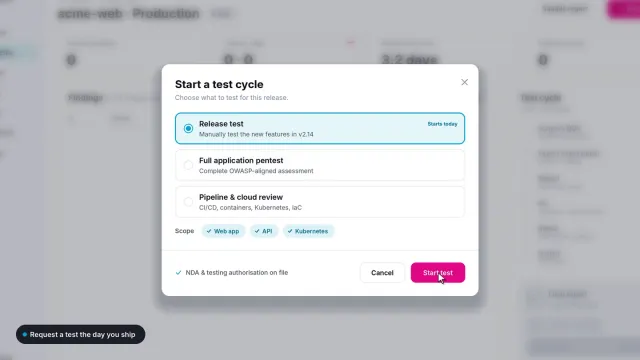
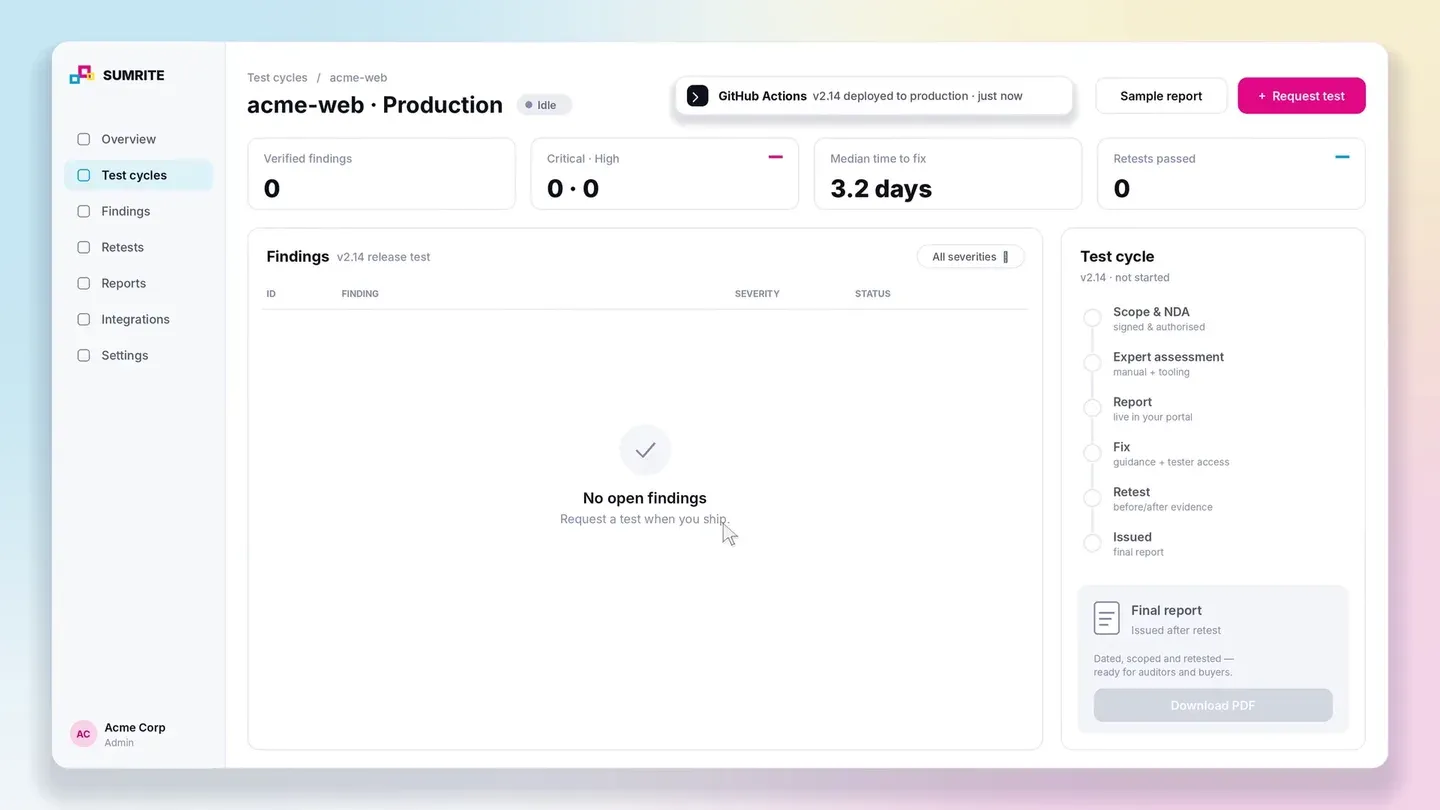
- A release triggers a test. A new version goes to production and you request a test from the platform, or your CI/CD pipeline flags the release. You choose a release test, a full application pentest or a pipeline and cloud review.
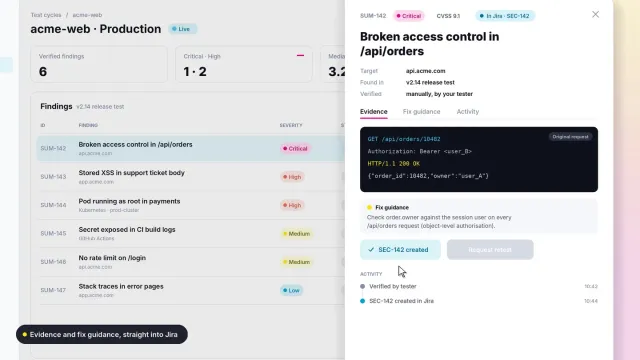
- Findings arrive live. As testers verify each issue it appears in the platform with severity, CVSS score, the request and response that prove it, and fix guidance.
- Findings go to Jira or GitHub. One click creates a ticket with the evidence and fix guidance, so the issue lands in the queue your engineers already use.
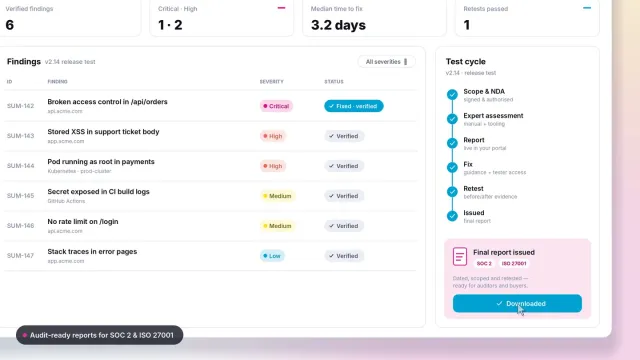
- Fixes are retested. When the fix ships you request a retest, attach what changed, and the tester confirms it. Nothing is closed on trust.
- Reports are always ready. Each cycle produces a dated, scoped and retested report for SOC 2, ISO 27001 and buyer security reviews.
PTaaS vs a traditional penetration test
- Cadence
- Traditional: once or twice a year. PTaaS: every significant release, plus full tests on a cycle.
- Where findings live
- Traditional: a PDF weeks after testing. PTaaS: a live platform, the moment each finding is verified.
- Developer workflow
- Traditional: someone copies findings into tickets. PTaaS: one-click Jira or GitHub tickets with evidence.
- Retests
- Traditional: often extra, often skipped. PTaaS: requested per finding, with before-and-after evidence.
- Audit evidence
- Traditional: one report, quickly out of date. PTaaS: a dated report for every cycle.
For a deeper comparison, read PTaaS vs traditional penetration testing.
What PTaaS is not
PTaaS is not a scanner with a dashboard. If findings appear that no person has verified, or the platform is mostly missing-header and version-disclosure items, you are buying automated scanning. Real PTaaS is about the issues that need a human: broken access control, business-logic abuse, authentication flaws and chained attacks. That is the line we draw in VAPT vs vulnerability scan.
When PTaaS makes sense
- You release to production weekly or monthly
- Enterprise customers send security questionnaires before they sign
- You need SOC 2, ISO 27001 or PCI DSS evidence of regular testing
- Your last pentest report no longer matches the product customers use
- Findings from past tests got lost between the PDF and the backlog
To see what to look for in a platform, read the PTaaS platform features that matter, and for pipeline-triggered testing see continuous penetration testing in CI/CD.
Watch the Sumrite PTaaS platform
See a release test from request to retest in the walkthrough on the continuous penetration testing page, or get a quote for your scope.
Frequently asked questions
What is PTaaS?
PTaaS, or penetration testing as a service, is expert-led penetration testing delivered continuously through a platform rather than as a one-off project. Testers check new releases as they ship, verified findings appear live with evidence and fix guidance, they can be sent to Jira or GitHub, and fixes are retested on request.
Is PTaaS just automated scanning?
No. A real PTaaS service is led by human testers. Automation covers the routine baseline, but every finding is tested by hand and verified before it is published, and the focus is the access-control, business-logic and chained issues scanners miss.
Who is PTaaS for?
Teams that ship often: SaaS companies, fintechs and product teams releasing weekly or monthly, and any company whose customers or auditors expect evidence of regular independent testing.
Does PTaaS replace an annual penetration test?
It can. A PTaaS programme includes full application tests on a regular cycle plus release-based testing in between, and you can export a dated report for any cycle for SOC 2, ISO 27001 or a customer questionnaire.
What does a PTaaS platform show?
Each test cycle and its scope, every verified finding with severity, CVSS score, evidence and fix guidance, its status from open to fixed and verified, the activity history, and the final reports for auditors and buyers.
Faisal Khan is a Director at Sumrite, where he oversees penetration testing, risk assessment and compliance engagements for SaaS and enterprise clients. Case studies are anonymised and published with client permission.