On this page
- Why web application VAPT matters so much for SaaS
- What a SaaS company must get right
- What is OWASP, and why your VAPT should follow it
- Manual testing at scale: how Summit does it
- For non-technical leaders: how to evaluate a VAPT provider
- What a web application VAPT engagement looks like
- What clients receive from Summit
- How to prepare your SaaS application for VAPT
- After the VAPT: turning findings into lasting security
- Why SaaS companies choose Summit
- Frequently asked questions
Why web application VAPT matters so much for SaaS
For a SaaS company, the web application is the product. It holds your customers’ data, carries their workflows and is the first thing their security team examines when your sales team gets close to a deal. Three things make security testing unavoidable:
Enterprise deals
Security questionnaires and vendor reviews almost always ask for a recent independent penetration test. Without one, procurement stalls.
Compliance
SOC 2, ISO 27001, PCI DSS and India's DPDP Act all expect evidence that technical vulnerabilities are found and fixed.
Real attackers
Most serious SaaS breaches come from flaws in the application itself: one customer reading another's data, weak authentication or exposed APIs.
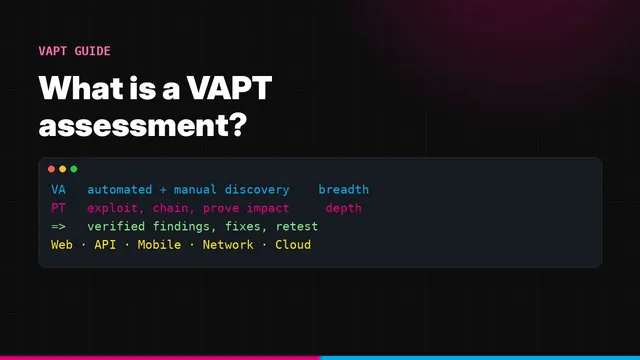
If VAPT is new to you, our explainer on what a VAPT assessment is covers the basics. This guide goes further, focusing on what a SaaS company in particular should insist on.
What a SaaS company must get right
Most security checklists are generic. These are the areas where SaaS products actually fail, and where your web application VAPT should spend most of its time.
1. Tenant isolation and access control
In a multi-tenant SaaS product, every customer’s data sits side by side. A single missing ownership check can let one customer read, edit or delete another’s records. This is the number one risk in the OWASP Top 10:2025 (Broken Access Control) and the most common high-severity finding in our reports. Our IDOR case study shows how one missing check cost a founder three major clients.
What to insist on: testing with accounts in at least two tenants, and every role in each, so the tester can try every action across those boundaries.
2. Authentication and session management
Login, sign-up, password reset, single sign-on, multi-factor authentication, invitations and session expiry are all common sources of account takeover. Cookie settings matter more than most teams realise; our guide to secure cookie flags and SameSite explains which to use.
3. The APIs behind the front end
Modern SaaS front ends are thin clients over APIs, and those APIs often expose more than the interface shows. Your test should cover the API directly, not just through the browser. Cross-origin policies are a frequent weak point; see how we fix a reflected Origin CORS misconfiguration.
4. Business logic
Price manipulation, skipping approval steps, abusing free trials, exceeding plan limits, replaying payment callbacks: scanners cannot find these because they do not understand your business. Only a human tester who learns your workflows can.
5. Integrations and file handling
Webhooks, imports and exports, file uploads, PDF generation, OAuth connections to third-party tools and outbound requests to customer-supplied URLs are classic entry points for server-side attacks.
6. Configuration and infrastructure
Security headers, TLS, error messages, exposed admin panels, cloud storage permissions and version banners. Individually small, these are the first things an attacker or an auditor’s scanner sees. Our hardening guides for the AWS ALB server header and the IIS Server header show typical fixes.
7. Data protection
Encryption in transit and at rest, secrets management, logging that does not leak personal data, and data retention. If you serve Indian users, the DPDP Act makes “reasonable security safeguards” a legal duty, with the largest penalties in the Act attached.
What is OWASP, and why your VAPT should follow it
OWASP (the Open Worldwide Application Security Project) is a non-profit community that publishes free, openly reviewed security guidance used by developers, testers and auditors worldwide. It is not a certification and does not approve products. Its value is that its documents give everyone, from your engineers to your customer’s security team, a shared and well-understood standard.
Four OWASP resources matter most for web application VAPT:
- OWASP Top 10
- The ten most critical web application security risk categories, updated every few years. The current edition is 2025.
- Web Security Testing Guide (WSTG)
- A detailed methodology describing how to test each area: information gathering, configuration, identity, authentication, authorisation, session management, input validation, error handling, cryptography, business logic and client-side.
- Application Security Verification Standard (ASVS)
- A catalogue of security requirements in three levels. Version 5.0, released in 2025, is widely used to define what "secure enough" means for an application.
- API Security Top 10
- The most critical risks specific to APIs, led by broken object-level authorisation.
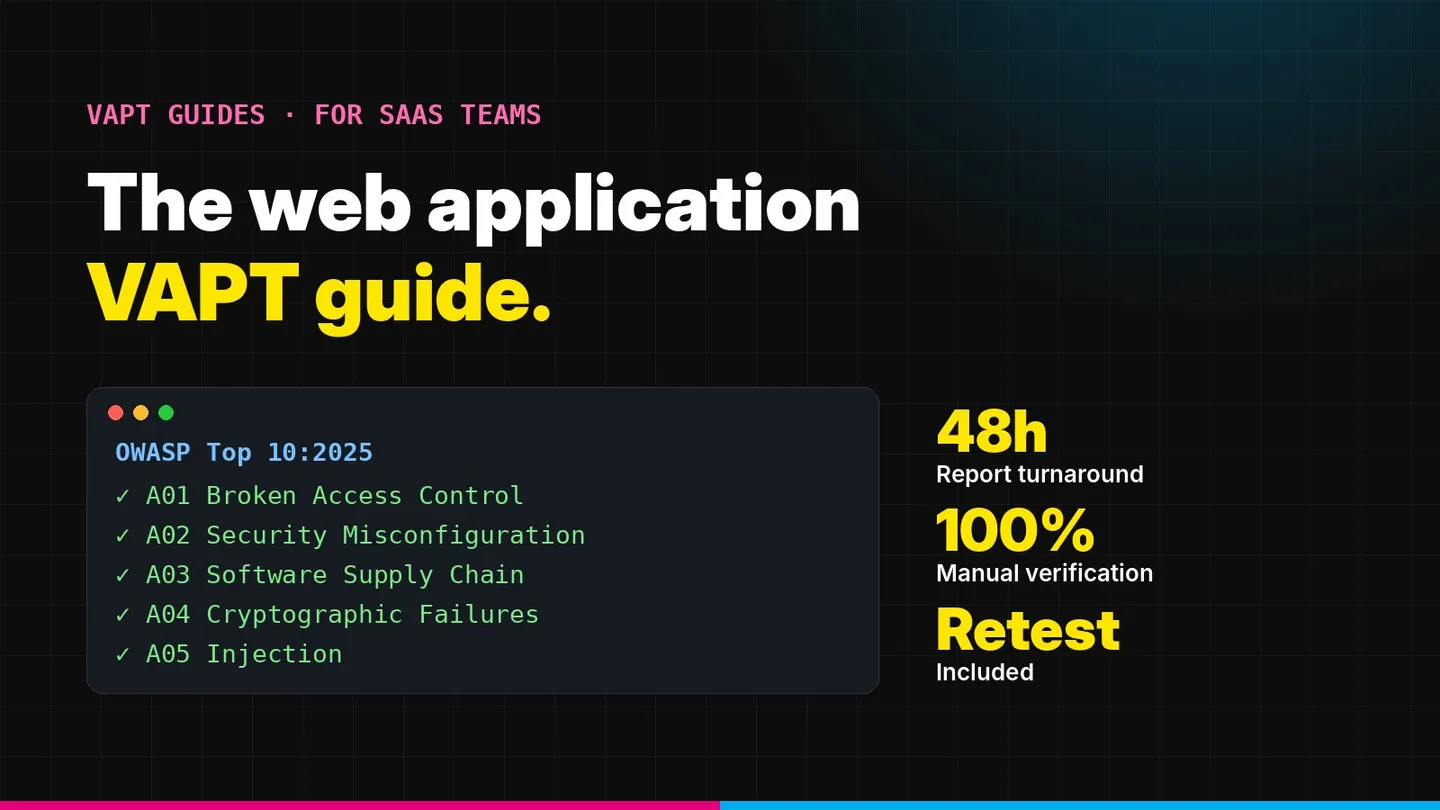
The OWASP Top 10:2025 at a glance
| Code | Risk | What it looks like in a SaaS product |
|---|---|---|
| A01 | Broken Access Control | One tenant reading another’s data; users reaching admin functions |
| A02 | Security Misconfiguration | Default settings, verbose errors, exposed consoles, permissive CORS |
| A03 | Software Supply Chain Failures | Vulnerable or compromised libraries, build pipelines and dependencies |
| A04 | Cryptographic Failures | Weak TLS, unencrypted sensitive data, poor key handling |
| A05 | Injection | SQL, command, template or cross-site scripting injection |
| A06 | Insecure Design | Workflows that can be abused even when the code is correct |
| A07 | Authentication Failures | Weak login, reset, MFA or session handling |
| A08 | Software or Data Integrity Failures | Unsigned updates, unsafe deserialisation, tampered webhooks |
| A09 | Security Logging and Alerting Failures | Attacks that happen without anyone noticing |
| A10 | Mishandling of Exceptional Conditions | Errors and edge cases that leak data or bypass checks |
Our OWASP Top 10 guide for SaaS teams explains each risk in more depth.
How Summit follows OWASP
- Every web application test is planned against the OWASP Web Security Testing Guide, so each area of the application is covered methodically, not by instinct alone.
- Every finding is mapped to its OWASP Top 10 category, so your engineers and your customers’ security teams immediately understand what it is.
- APIs are tested against the OWASP API Security Top 10, and mobile apps against OWASP MASVS.
- Where you need a defined assurance level, we map results to OWASP ASVS requirements, which makes it easy to show progress between tests.
- Findings are rated with CVSS and explained in business terms, so the severity is never just a number.
Manual testing at scale: how Summit does it
The difference between a VAPT that protects your business and one that sits in a drawer is manual testing. Scanners are fast and useful for known patterns, but they cannot log in as two customers and check whether one can see the other’s invoices, or understand that your discount code can be applied twice. Those are the flaws that cause real breaches.
The usual objection is that manual testing is slow and does not scale. We built Summit to remove that trade-off:
- A structured test library. Every engagement runs through a library of more than 150 test parameters derived from the OWASP Testing Guide and our own findings, so nothing is left to memory.
- A role and tenant matrix. Before testing begins we map every role, tenant and sensitive action, then test each combination systematically. This is how access-control flaws are found reliably instead of by luck.
- Automation for coverage, humans for judgement. Tooling handles crawling, discovery and known-vulnerability checks so testers spend their time on authentication, authorisation and business logic.
- Parallel specialists. Larger applications are split across testers by area, then brought together for chained attacks, which keeps turnaround short without cutting depth.
- Verification and peer review. Every finding is reproduced and evidenced by a tester, then reviewed before it reaches your report. No unverified scanner output, ever.
- Retest built in. Once your team has fixed the findings, we retest and update the report, so you can show customers and auditors the issues are closed.
The result is depth that matches a long traditional engagement, delivered at the pace a SaaS company works: a quote usually within 15 minutes and a report for a standard web application or API within 48 hours of testing.
For non-technical leaders: how to evaluate a VAPT provider
You do not need to be a security expert to choose a good provider. You need to compare them on the right things, in the same way. Use this scorecard: give each provider a score from 1 to 5 on each criterion, multiply by the weight and add up the totals.
| Criterion | Weight | What a 5 looks like |
|---|---|---|
| Manual testing depth | 25% | Most of the effort is manual; every role and tenant is tested; business logic is in scope |
| Report quality | 20% | Clear executive summary, evidence for every finding, specific fixes, framework mapping |
| Tester experience | 15% | You know who will test; they have tested similar products and can explain their approach |
| Retest and support | 15% | Retest included; testers available to your engineers during fixes |
| Compliance fit | 10% | Report maps to the framework your customers or auditors ask for |
| Speed and responsiveness | 10% | Fast quote, clear start date, critical issues reported immediately |
| Data handling | 5% | NDA before scope; credentials and findings handled securely |
Five questions any non-technical founder can ask:
- “Can I see a redacted sample report?” If it looks like a scanner export, walk away.
- “How much of the testing is manual, and how do you test that one customer cannot access another’s data?”
- “Is the retest included, and how quickly will you retest?”
- “Will the report work for our SOC 2 auditor, ISO 27001 certification or this customer’s questionnaire?”
- “Who exactly will test our product, and can our engineers talk to them?”
The cheapest quote is rarely the cheapest outcome
A low price for a large scope usually means an automated scan with a branded cover page. It will not find the access-control and logic flaws that cause breaches, and experienced enterprise security teams and auditors will recognise it.
What a web application VAPT engagement looks like
Scoping (day 0)
A short call, NDA first, then a written scope listing applications, roles, environments and exclusions, with a fixed quote.
Preparation
You provide test accounts for each role and tenant, API documentation and a technical contact. We agree testing windows and an emergency contact.
Testing
Reconnaissance, automated discovery and in-depth manual testing across the OWASP areas. Critical issues are reported to you immediately.
Report and debrief
Report delivered, followed by a walkthrough with your engineers and, if you wish, a short summary for leadership.
Fix and retest
Your team fixes the findings; we retest and update the report so it shows the closed status.
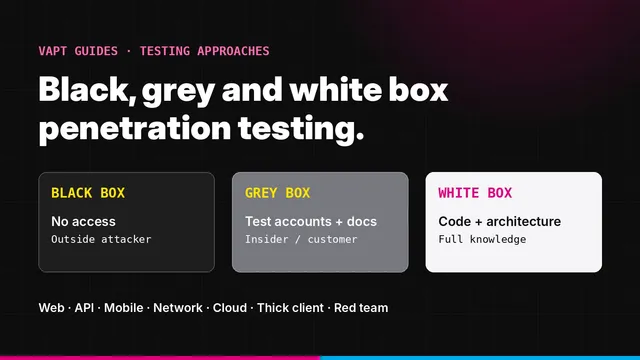
Unsure whether you need black, grey or white box testing? Our guide to the types of penetration testing explains the options. For most SaaS applications, authenticated grey box testing gives the best coverage.
What clients receive from Summit
Executive summary
A plain-language overview of risk for founders, boards and customers: what was tested, what was found and what it means for the business.
Detailed technical findings
Every issue with severity, OWASP category, evidence, reproduction steps and specific remediation for your technology stack.
Compliance mapping
Findings mapped to SOC 2, ISO 27001, PCI DSS or the DPDP Act, depending on who will read the report.
Remediation support
Direct access to the testers while your engineers fix issues, so questions are answered by the people who found them.
Retest and updated report
Confirmation that fixes work, with the report updated to show closed findings.
Shareable assurance
On request, a summary letter you can share with prospects and customers without exposing technical detail.
See exactly what this looks like in our sample VAPT report. If you are working towards a specific framework, our guides to the SOC 2 VAPT report and ISO 27001 VAPT explain what auditors look for.
How to prepare your SaaS application for VAPT
- Decide the environment. Staging is fine if it matches production in code and configuration.
- Create test accounts for every role, in at least two tenants, with realistic sample data.
- Share API documentation, such as an OpenAPI file or Postman collection.
- List integrations, webhooks and file-processing features so they are not missed.
- Tell the testers about anything fragile, rate limits, and actions that must not be triggered, such as real payments or emails to customers.
- Make sure logging and backups are working, and that your engineers know the dates.
- Name one technical contact who can answer questions quickly during testing.
After the VAPT: turning findings into lasting security
A report is only valuable if it changes things. The SaaS teams that get the most from VAPT:
- Fix critical and high findings first, then plan medium and low issues into normal sprints
- Ask why each issue happened, and fix the pattern, such as a missing authorisation check in a shared library, not just the single endpoint
- Add regression tests for fixed vulnerabilities so they do not return
- Retest before sharing results with customers or auditors
- Schedule the next test around major releases, not just the calendar
Why SaaS companies choose Summit
Summit was built for exactly this problem: SaaS teams that need security testing deep enough to trust and fast enough to keep up with sales cycles and audits.
- Manual testing at the core, with every finding verified and evidenced by a tester
- Built for SaaS: role and tenant matrices, API-first testing and business-logic focus as standard
- OWASP throughout: methodology, mapping and reporting aligned with the Testing Guide, Top 10, API Top 10 and ASVS
- Speed without shortcuts: quotes usually within 15 minutes and reports within 48 hours of testing
- Reports for three audiences: leadership, engineers and auditors
- Retest included, plus direct access to the testers while you fix
- One accountable team, based in New Delhi and working with SaaS companies worldwide
Ready to test your web application?
Tell us about your application, its roles and who is asking for the report. We will send a fixed scope and quote, with a sample report so you know exactly what you will receive. Get a quote or explore our web application VAPT service.
Frequently asked questions
What is web application VAPT?
Web application VAPT (vulnerability assessment and penetration testing) is a security test of a web application in which testers first identify weaknesses and then try to exploit them, the way a real attacker would. For a SaaS product it covers the login and session handling, user roles and tenant separation, business workflows, APIs behind the front end, and the configuration the application runs on.
How often should a SaaS company run web application VAPT?
At least once a year, and after any significant change such as a new major feature, a change to authentication, a new integration or an infrastructure migration. Fast-moving SaaS teams increasingly test before major releases or on a quarterly cycle, with a retest after each round of fixes.
Is OWASP a certification for my application?
No. OWASP is an open community that publishes free security guidance, such as the OWASP Top 10, the Web Security Testing Guide and the Application Security Verification Standard. A VAPT that follows OWASP shows your application was tested against widely recognised criteria, but OWASP does not certify applications.
How long does a web application VAPT take?
It depends on the size of the application and the number of roles. Summit delivers the report for a standard web application or API within 48 hours of testing; larger platforms take longer. Retesting of fixed findings is included.
What do I need to provide before a web application VAPT?
A written scope and authorisation, the URLs or environments in scope, test accounts for every user role (two tenants for multi-tenant SaaS), API documentation if available, and a technical contact. Staging is often used, provided it matches production.
Can non-technical founders evaluate a VAPT provider?
Yes. Ask to see a redacted sample report, ask how much of the testing is manual, check that retesting is included, confirm the report maps to the framework your customers or auditors use, and score providers on the same criteria. The scorecard in this guide is designed for exactly that.