On this page
- What VAPT means
- Why you need a VAPT assessment
- Types of VAPT
- Black box, grey box and white box testing
- How a VAPT assessment works, step by step
- What a VAPT report contains
- What VAPT typically finds
- VAPT vs vulnerability scanning: why “automated VAPT” is not enough
- How much does VAPT cost and what drives it?
- How to choose a VAPT provider
- VAPT in India: regulatory context
- VAPT for UAE companies: DIFC, ADGM, CBUAE and the UAE PDPL
- VAPT for Saudi Arabia: NCA ECC, SAMA and the Saudi PDPL
- How to prepare for a VAPT
- After the VAPT: from findings to fixes
- VAPT terms you will hear
- VAPT vs bug bounty programmes
- A VAPT checklist for startups
- Get a VAPT assessment from Summit
- Frequently asked questions
What VAPT means
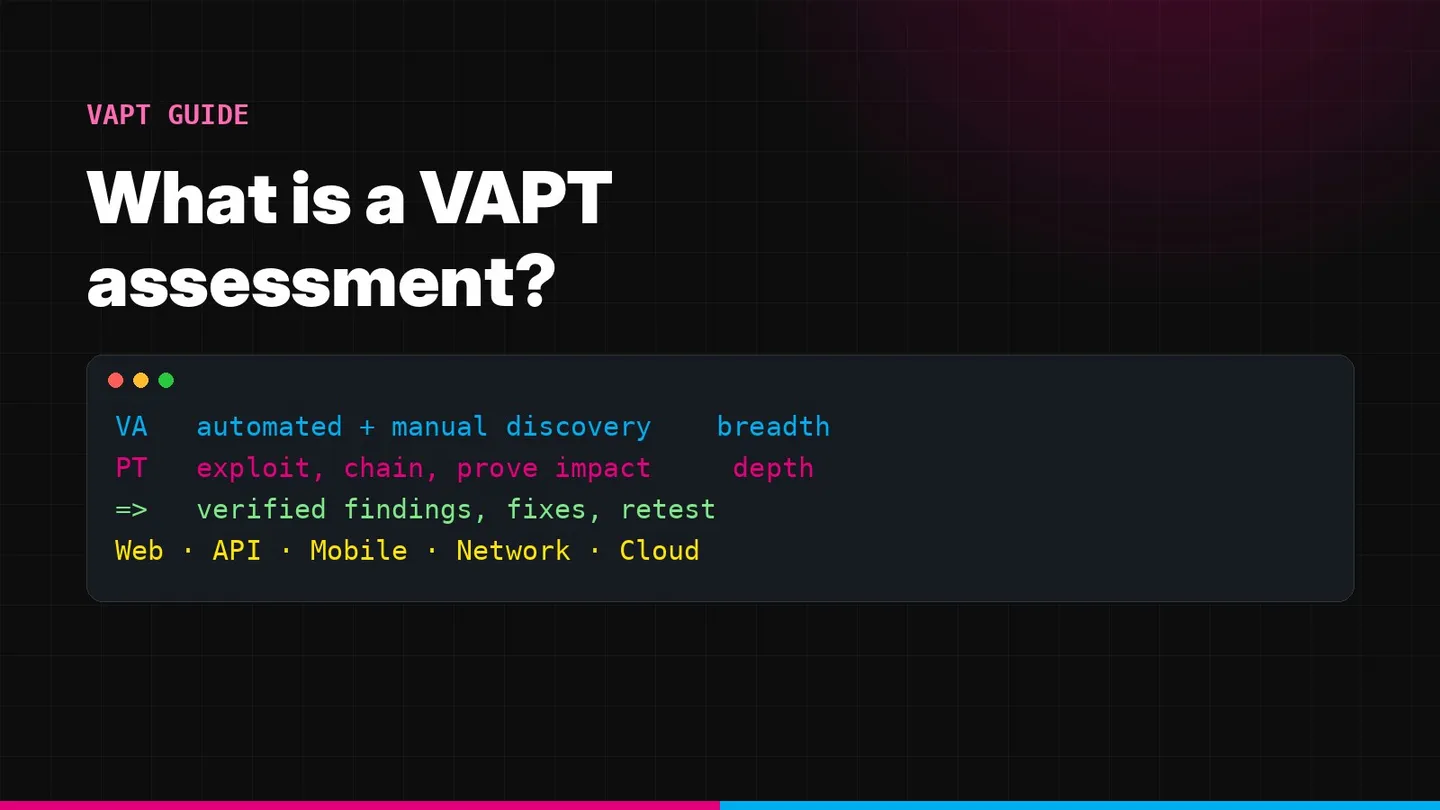
VAPT is short for Vulnerability Assessment and Penetration Testing. It combines two activities that are often confused but answer different questions:
Vulnerability assessment (VA)
What weaknesses exist? Systematic discovery of known vulnerabilities and misconfigurations across your systems, using scanners plus expert review. Broad, fast, repeatable.
Penetration testing (PT)
Which weaknesses matter? A skilled tester tries to exploit them the way a real attacker would, chains them together and shows the actual impact. Deep, manual, creative.
Put together, VAPT gives you a prioritised, evidence-backed list of security problems and how to fix them. The word “assessment” is important: a good VAPT is a judgement by experienced people, not just the output of a tool.
Why you need a VAPT assessment
Most organisations come to VAPT for one of five reasons. Usually it is more than one.
- A customer asked for it. Enterprise buyers send security questionnaires that ask for a recent third-party penetration test. Without one, deals stall in procurement.
- An audit or regulation requires evidence. SOC 2, ISO 27001, PCI DSS, HIPAA, RBI and SEBI frameworks, and the DPDP Act’s reasonable security safeguards all expect testing evidence in some form.
- You are about to launch or change something big. A new product, a major release, a new payment flow or a cloud migration is the best time to find problems, before attackers and customers do.
- Something happened. A suspicious incident, a bug bounty report or a competitor’s breach makes leadership ask how exposed you are.
- You want to know. Security teams use VAPT to measure whether their controls work in practice, not just on paper.
What it costs not to test
Our IDOR case study describes a SaaS company that lost three major clients after a competitor downloaded 12,000 customer records through one unchecked API parameter. The flaw took 20 minutes to find in testing and four hours to fix. The breach had already cost far more than the test.
Types of VAPT
VAPT is not one product. The type depends on what you are protecting:
- Web application VAPT
- Customer portals, SaaS products and admin panels. Authentication, authorisation, injection, business logic and session handling.
- API security testing
- REST, GraphQL and gRPC APIs used by web, mobile and partners. Object-level and function-level authorisation are the biggest risks.
- Mobile app VAPT
- iOS and Android apps: local data storage, certificate pinning, reverse engineering and the APIs behind them.
- Network VAPT
- External perimeter and internal networks: exposed services, patching, Active Directory and segmentation.
- Cloud security assessment
- AWS, Azure and GCP configuration: IAM, storage, network exposure, logging and secrets.
- Source code review
- Manual and tool-assisted review of code for vulnerabilities that testing from outside may not reach.
- Thick client VAPT
- Desktop applications and their communication with servers.
- Red team and phishing
- Goal-based attack simulation and social engineering to test people, processes and detection, not just technology.
Each has its own page: web application VAPT, API security testing, mobile app VAPT, network VAPT and cloud security assessment.
Black box, grey box and white box testing
Testers can start with different amounts of knowledge. The choice changes what the test finds and how efficient it is.
Black box
No credentials or internal information, like an outside attacker. Realistic for the perimeter, but much of the time goes on discovery and authenticated features may never be tested.
Grey box
Test accounts for each role and basic documentation. The most common and usually best value choice, because it tests what logged-in users and attackers with stolen accounts can do.
White box
Full access to source code, architecture and configuration. The most thorough, often combined with code review for high-risk systems.
How a VAPT assessment works, step by step
- Scoping. Agree what is in and out of scope: URLs, APIs, apps, IP ranges, cloud accounts, environments, roles and testing windows. An NDA and written authorisation come first.
- Reconnaissance. Map the attack surface: subdomains, endpoints, technologies, exposed services and data flows.
- Vulnerability assessment. Automated scanning and manual review to find known weaknesses and misconfigurations.
- Manual penetration testing. Testers attempt to exploit findings, test authorisation between users and tenants, abuse business logic and chain issues together, following methodologies such as the OWASP Web Security Testing Guide and NIST SP 800-115.
- Analysis and severity rating. Each confirmed finding is rated by real-world impact and likelihood, often using CVSS adjusted for business context.
- Reporting. An executive summary for leadership and detailed findings with evidence and fixes for engineers.
- Remediation support. Testers explain findings and review proposed fixes with your developers.
- Retest. Fixed findings are tested again and their status is recorded, giving you evidence of closure.
What a VAPT report contains
The report is what you keep, share with auditors and act on. A good one includes:
- Executive summary with overall risk and key themes
- Scope, dates, methodology and test approach
- Each finding with severity, affected assets, description, evidence, impact and specific remediation
- A summary table of findings by severity and status
- Retest results showing which findings are fixed and verified
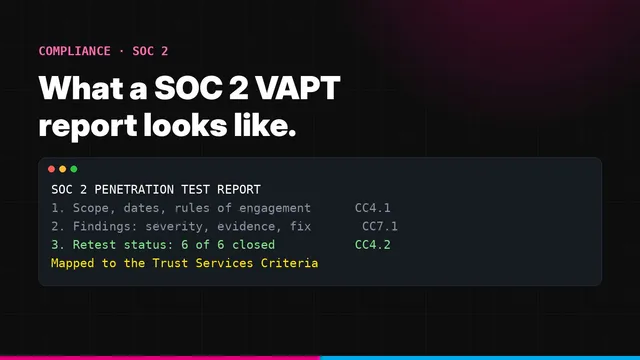
See a full example in our sample VAPT report, or our walkthrough of a SOC 2 VAPT report.
What VAPT typically finds
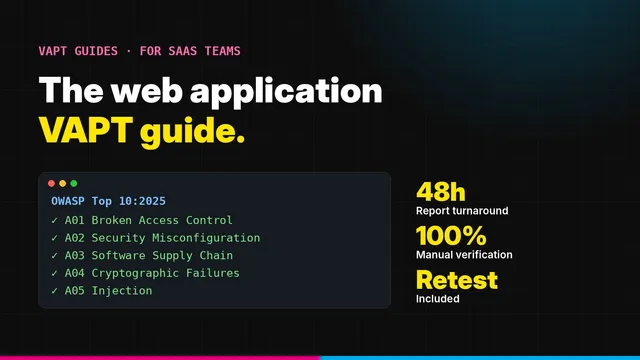
In the tests we run, the same categories come up again and again, broadly matching the OWASP Top 10:
Broken access control
Users reading or changing other users' or tenants' data. The most common serious finding in SaaS and APIs.
Authentication weaknesses
Weak password policies, missing MFA on admin accounts, flawed password reset and session handling.
Injection
SQL, command and template injection where input reaches interpreters unsafely.
Security misconfiguration
Permissive CORS, verbose errors, default credentials, exposed admin panels and missing security headers.
Vulnerable components
Outdated libraries, frameworks and server software with known vulnerabilities.
Cloud and network exposure
Public storage buckets, over-privileged IAM roles, open management ports and flat internal networks.
Several of our hardening guides cover these in detail, such as fixing a CORS misconfiguration and setting secure cookie flags.
VAPT vs vulnerability scanning: why “automated VAPT” is not enough
Many services sell a scanner run as “VAPT”. Scanners are useful, but they cannot judge business logic, understand which data belongs to which user, or chain small issues into a serious one. They also produce false positives that waste engineering time.
- Finds known CVEs and misconfigurations
- Scanning: yes. Manual VAPT: yes
- Finds broken authorisation between users and tenants
- Scanning: rarely. Manual VAPT: yes
- Finds business logic flaws
- Scanning: no. Manual VAPT: yes
- Proves real impact with evidence
- Scanning: no. Manual VAPT: yes
- False positives removed
- Scanning: no. Manual VAPT: yes
- Accepted as penetration test evidence by auditors and enterprise buyers
- Scanning: usually not. Manual VAPT: yes
Use scanning continuously, and manual VAPT periodically and after big changes. They complement each other.
How much does VAPT cost and what drives it?
Prices vary widely because scope varies widely. The main cost drivers are:
- Number and size of applications, APIs, endpoints, mobile apps and hosts
- Number of user roles and tenants to test
- Testing depth: black, grey or white box, and whether code review is included
- Environment complexity: cloud accounts, microservices, integrations
- Compliance mapping and reporting requirements
- Whether retesting is included
Compare quotes on the same written scope and ask how much of the time is manual testing. A low price for a large scope usually means mostly automated scanning.
How to choose a VAPT provider
- Ask for a sample report and check it for evidence, specific remediation and a retest section.
- Ask who will do the testing and what hands-on experience they have.
- Confirm the methodology and how much is manual.
- Check your regulatory and contractual requirements: which frameworks apply, what evidence they expect and whether your customers have their own testing clauses.
- Confirm confidentiality: NDA, data handling and how findings are shared.
- Make sure a retest is included, so you can prove fixes.
Our roundup of VAPT companies in India compares several providers on these criteria.
VAPT in India: regulatory context
For Indian organisations, VAPT often has a regulatory dimension as well as a commercial one:
- RBI
- Banks and other regulated entities are expected to test their applications and infrastructure regularly as part of their cyber security frameworks.
- SEBI
- The Cybersecurity and Cyber Resilience Framework (CSCRF) requires regulated entities to carry out VAPT and cyber audits on a defined cadence.
- DPDP Act
- Every data fiduciary must take reasonable security safeguards. Regular testing is the clearest evidence they work.
- Customer contracts
- Enterprise buyers increasingly write annual third-party testing into security addenda, whatever your sector.
Requirements depend on your sector and entity category, so check the current circulars that apply to you. Our guide to the DPDP Act and the SEBI CSCRF and RBI guide cover the details.
VAPT for UAE companies: DIFC, ADGM, CBUAE and the UAE PDPL
The UAE is one of the most security-conscious buyer markets in the world, and a recent, independent penetration test is a routine request in Dubai and Abu Dhabi procurement, vendor onboarding and regulatory reviews. Summit has helped more than 100 companies across the Gulf region secure their applications and meet the testing and audit requirements that come with doing business there, from fast-moving fintech and SaaS teams to established enterprises selling into banks and government-linked buyers.
100+
Companies helped across the Gulf region
48 hours
Typical turnaround for a standard web or API report
Manual
Human-verified findings, not scanner output
In the UAE, VAPT usually has to answer one of these questions:
- DIFC
- Firms in the Dubai International Financial Centre are expected to maintain appropriate technical and organisational security under the DIFC Data Protection Law, and customers in the centre ask vendors for current testing evidence.
- ADGM
- Abu Dhabi Global Market entities have similar data protection and technology risk expectations, and a penetration test report is a standard supporting document.
- CBUAE
- Banks, payment providers and other Central Bank regulated firms operate under technology risk and operational resilience expectations that include regular vulnerability assessment and penetration testing.
- UAE PDPL
- Federal Decree-Law 45 of 2021 requires controllers and processors to protect personal data with appropriate security measures. Testing is the practical evidence that those measures work.
- Enterprise and government buyers
- Large UAE buyers send security questionnaires and vendor reviews that ask for a recent independent report, a remediation record and a retest.
What UAE teams get from working with Summit:
- A report mapped to the controls your reviewer, regulator or customer is asking about, with executive summary, evidence for every finding and developer-ready fixes
- Manual testing of the things that matter most to UAE buyers: authentication, authorisation between users and tenants, payment and data flows, and the APIs behind them
- Fast turnaround, so a pending review or a stalled deal is not waiting weeks for a report
- Retesting of fixed findings, so you can show the issues are closed
- An NDA before any technical discussion, and remote delivery that works across Dubai and Abu Dhabi time zones
Summit is based in New Delhi and delivers all UAE engagements remotely. See the dedicated VAPT for Dubai and UAE page, or read the guides to DIFC and ADGM and the UAE PDPL.
VAPT for Saudi Arabia: NCA ECC, SAMA and the Saudi PDPL
Saudi Arabia’s Vision 2030 digital programmes have made security testing a baseline requirement for companies that sell to Saudi enterprises, banks and government entities. Summit has helped more than 100 companies across the Gulf region, including those serving the Kingdom, meet the testing and audit requirements their Saudi customers and regulators set. Most of the work is the same discipline behind every good VAPT, with the evidence organised the way Saudi reviewers expect to see it.
Saudi buyers and regulators typically ask for testing evidence against:
- NCA Essential Cybersecurity Controls (ECC)
- The National Cybersecurity Authority baseline for government and critical national infrastructure organisations includes vulnerability management and penetration testing. Suppliers to those organisations are routinely asked for the same evidence.
- NCA cloud and data controls
- Cloud Cybersecurity Controls (CCC) and Data Cybersecurity Controls (DCC) shape what cloud-hosted and data-heavy services must demonstrate.
- SAMA Cyber Security Framework
- Banks, insurers and finance companies supervised by the Saudi Central Bank are expected to run regular penetration tests and to hold their suppliers to the same standard.
- Saudi PDPL
- The Personal Data Protection Law, enforced by SDAIA, requires appropriate security measures for personal data, and testing is the clearest way to evidence them.
- Enterprise questionnaires
- Large Saudi buyers send detailed security questionnaires and expect a recent independent report with a remediation and retest record.
What Saudi-facing teams get from working with Summit:
- A manual penetration test of the applications, APIs, mobile apps and cloud environments that Saudi customers will actually review
- A report that sets out findings, evidence and fixes clearly enough to attach to a questionnaire or vendor file, with a short management summary for non-technical reviewers
- Quick turnaround when a bid, onboarding or audit deadline is close
- Free retesting of fixed findings, so closure can be demonstrated
- Strict confidentiality, with an NDA signed before scope is discussed
Summit is based in New Delhi and delivers all Saudi engagements remotely. See the VAPT for Saudi Arabia page, or read the guides to NCA ECC and the Saudi PDPL.
Selling into the Gulf?
Send us the questionnaire, tender clause or regulatory requirement that is asking for a penetration test. We will confirm what it needs, scope the work and tell you how quickly we can deliver. Talk to us about UAE and Saudi testing.
How to prepare for a VAPT
A little preparation makes the test faster and the results more useful:
- List the assets in scope with URLs, API documentation, app builds and IP ranges
- Create test accounts for every role, in at least two separate tenants or organisations for SaaS products
- Decide on the environment: production, or staging that mirrors production closely
- Tell your hosting provider, WAF or SOC team about the test window, or decide deliberately not to, if you want to test detection
- Name a technical contact who can answer questions and unblock testers quickly
- Back up data in non-production environments, in case testing modifies it
After the VAPT: from findings to fixes
The report is the start of the work, not the end. Teams that get the most from VAPT follow the same pattern:
- Hold a debrief call with the testers to understand the critical and high findings.
- Create a ticket for every finding, with an owner and a due date based on severity.
- Fix root causes, not just symptoms. Ten access-control bugs usually mean one missing central check.
- Ask for a retest once fixes are deployed, and keep the retest results as evidence.
- Feed lessons into your development process, for example new code review checks or tests in your pipeline.
VAPT terms you will hear
- CVSS
- Common Vulnerability Scoring System, a standard way to rate the technical severity of a vulnerability from 0 to 10
- False positive
- A scanner result that looks like a vulnerability but is not exploitable
- IDOR / BOLA
- Insecure direct object reference, or broken object level authorisation: accessing other users' data by changing an identifier
- OWASP
- The Open Worldwide Application Security Project, which publishes the Top 10 and testing guides
- Retest
- Testing fixed findings again to confirm they are closed
- Rules of engagement
- The agreed limits of a test: timing, techniques allowed and who to contact
VAPT vs bug bounty programmes
Bug bounties pay independent researchers for vulnerabilities they report. They complement VAPT but do not replace it:
VAPT
A defined scope tested thoroughly by a contracted team, with a report and retest you can show auditors and customers. Predictable cost and timing.
Bug bounty
Continuous, crowd-sourced testing paid per valid finding. Good at finding unusual issues over time, but coverage is uneven and there is no structured report for compliance.
Most mature organisations run regular VAPT first, then add a bug bounty or vulnerability disclosure programme once the obvious issues are fixed.
A VAPT checklist for startups
- Test before your first enterprise deal, not during it; procurement reviews move faster with a recent report in hand
- Start with the customer-facing application and its API, tested with real roles and two tenants
- Add a cloud configuration review once you are on AWS, Azure or GCP in production
- Fix critical and high findings first, and ask for a retest so you can say they are closed
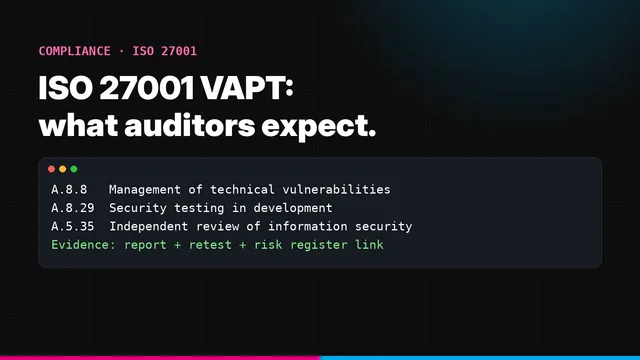
- Repeat at least annually and after major changes, and keep reports for your SOC 2 or ISO 27001 audit
Get a VAPT assessment from Summit
Summit, based in New Delhi, delivers manual VAPT for web applications, APIs, mobile apps, networks and cloud for SaaS and enterprise teams in India and worldwide. Every engagement includes an NDA before scope, verified findings with evidence, a report your auditors and customers can use, and a retest of fixed findings.
Ready to test?
Tell us what you need tested and why, and we will send a fixed scope and quote. Browse all services, see a sample report or get a quote.
Frequently asked questions
What is the full form of VAPT?
VAPT stands for Vulnerability Assessment and Penetration Testing. Vulnerability assessment finds and lists weaknesses across your systems; penetration testing attempts to exploit them to show which ones are real and how much damage they could cause.
What is the difference between a vulnerability assessment and a penetration test?
A vulnerability assessment is broad and largely automated: it finds known weaknesses across many systems quickly. A penetration test is deep and manual: a tester tries to exploit weaknesses, chain them together and reach sensitive data, which shows real impact and catches logic flaws scanners miss.
How long does a VAPT assessment take?
It depends on scope. A single web application or API typically takes three to ten working days of testing, a network a few days to several weeks, and a combined assessment longer. Reporting and retesting add time after testing finishes.
How much does a VAPT cost?
Cost depends on the number and size of applications, APIs and hosts, the depth of testing, the environment and whether a retest is included. Ask for a fixed quote based on a written scope rather than a per-scan price, because scan-only services are not comparable to manual testing.
How often should a company do VAPT?
At least once a year for internet-facing and critical systems, after significant changes such as a major release or cloud migration, and whenever a customer, auditor or regulator requires it. Vulnerability scanning should run more often, monthly or continuously.
Is a VAPT certificate the same as a VAPT report?
No. A report contains the scope, findings, evidence and fixes. A certificate or attestation letter is a short summary that the testing was done and findings were addressed, often shared with customers. Auditors usually want the report or at least the executive summary and retest results.
Do you provide VAPT for companies in the UAE and Dubai?
Yes. Summit has helped more than 100 companies across the Gulf region with penetration testing, delivered remotely from New Delhi. Reports are mapped to what DIFC, ADGM, CBUAE and the UAE PDPL reviews ask for, with a retest of fixed findings included.
Do you provide VAPT for companies in Saudi Arabia?
Yes. Summit tests web applications, APIs, mobile apps and cloud environments for companies serving Saudi customers, with reports organised around NCA ECC, SAMA and Saudi PDPL expectations. Engagements are delivered remotely and include a retest.