On this page
- How often are Saudi organisations attacked compared with the rest of the Middle East?
- Which Saudi sectors are attacked most in 2026?
- How are attackers breaking into Saudi organisations?
- Which ransomware and hacktivist groups are targeting Saudi Arabia?
- What does a successful cyber attack cost a Saudi business?
- What do these threats mean for NCA ECC and PDPL obligations?
- How do you test whether your defences would stop these attacks?
- How Sumrite helps
- Frequently asked questions
This post collects the threat numbers that matter to Saudi security teams, as of November 2026, and only the ones we could trace to the publisher’s own page. Every figure below links to its source. Where a widely shared statistic could not be traced back to the original publisher, we left it out.
The last section turns the data into a testing plan, because a threat report is only useful if it changes what you check next quarter.
Data window and refresh cycle
The threat data here comes mainly from Positive Technologies’ Current Cyberthreats in the Middle East research, which covers Q2 2025 to Q1 2026 (data to 11 March 2026), and from IBM’s 2026 Cost of a Data Breach findings for Saudi Arabia, released in August 2026. We review this page quarterly.
How often are Saudi organisations attacked compared with the rest of the Middle East?
Saudi Arabia was the second most targeted country in the Middle East between Q2 2025 and Q1 2026, with 12% of successful cyber attacks in the region. Positive Technologies ranked Israel first (33%) and the UAE third (11%).
The pace also picked up sharply. In its Middle East threat report, Positive Technologies notes that Q1 2026 alone accounted for 51% of all attacks recorded during the twelve-month reporting period. The same report says attacks on Saudi Arabia peaked in Q2 2025, at 26%.
- Israel
- 33% of successful attacks in the Middle East (Q2 2025 to Q1 2026)
- Saudi Arabia
- 12%
- UAE
- 11%
- Share of the year's attacks that fell in Q1 2026
- 51%
- Source
- [Positive Technologies, Current Cyberthreats in the Middle East](https://global.ptsecurity.com/en/research/analytics/cyber-threats-in-the-middle-east/)
Positive Technologies counts publicly reported and observed successful attacks, so these are shares, not absolute totals. They show where attackers are focusing, not how many attempts each country absorbs.
Which Saudi sectors are attacked most in 2026?
Government agencies are the most attacked sector in Saudi Arabia, at 35% of successful attacks on Saudi organisations between Q2 2025 and Q1 2026. In Q1 2026 alone, government entities accounted for 71% of attacks on Saudi organisations, according to Positive Technologies.
The Positive Technologies executive summary breaks the Saudi picture down further:
| Saudi victim category (Q2 2025 to Q1 2026) | Share of successful attacks |
|---|---|
| Government agencies | 35% |
| Manufacturing and industry | 20% |
| Retail | 10% |
| Services | 10% |
Positive Technologies expects manufacturing and services to stay key targets as regional conflict de-escalates. For private-sector firms, that forecast matters more than the government headline. In our experience, suppliers and contractors to government entities share much of the same exposure, so a government-heavy threat picture is not a reason for private firms to relax.
How are attackers breaking into Saudi organisations?
Malware is the most common method in attacks on Saudi organisations, used in 55% of cases, followed by vulnerability exploitation at 40%, according to the Positive Technologies executive summary for Q2 2025 to Q1 2026. DDoS attacks and social engineering each appeared in 30% of attacks (one attack can use several methods, so the shares add up to more than 100%).
The 40% figure for vulnerability exploitation stands out. Across the whole region Positive Technologies put exploitation at 21%, so attackers going after Saudi targets rely on unpatched or misconfigured systems roughly twice as often as the regional average.
What attackers target and what they take
Region-wide, the Positive Technologies report found:
- Computers, servers and network equipment were the most frequent targets, at 63% of affected assets.
- Web resources came second, at 49%. These are the websites, portals and APIs that every Saudi business exposes to the internet.
- Operational disruption was the most common result (60% of successful attacks), followed by confidential data leaks (44%).
For Saudi victims, the stolen data that could be categorised was mostly trade secrets (25%) and credentials (15%), with 40% falling into an “other information” category. Stolen credentials matter because they enable the next intrusion. IBM’s Saudi data (below) shows that breaches using valid accounts are among the most expensive.
- Malware: 55% of attacks on Saudi organisations
- Vulnerability exploitation: 40% (regional average: 21%)
- DDoS: 30%
- Social engineering: 30%
- Web resources: 49% of affected assets region-wide
Which ransomware and hacktivist groups are targeting Saudi Arabia?
Positive Technologies names several ransomware groups active against Saudi organisations between Q2 2025 and Q1 2026, including Tengu, Ralord, Cl0p, Everest, Qilin and RansomEXX. Ransomware made up 30% of the malware types seen in the region, the largest single category.
Specific incidents in the Positive Technologies report include:
- Tengu hit a Saudi healthcare organisation.
- Ralord attacked a Saudi water infrastructure company.
- Cl0p listed Saudi organisations among its victims.
- Everest and Qilin were also active in Saudi Arabia, and RansomEXX (tracked as Storm-2460) was observed there too.
Hacktivists are the second pressure point. Positive Technologies attributes DDoS attacks on Saudi government websites mainly to the Fearless group, and reports that Cyber Islamic Resistance and 313 Team defaced a Saudi university website. Hacktivist DDoS rarely leads to data theft, but it takes services offline. A defacement shows that a web server was compromised, which is a more serious problem.
For a deeper look at how ransomware crews choose their targets in the Kingdom, see our companion post on ransomware in Saudi Arabia. For the social-engineering side, see AI-powered phishing in Saudi Arabia.
What does a successful cyber attack cost a Saudi business?
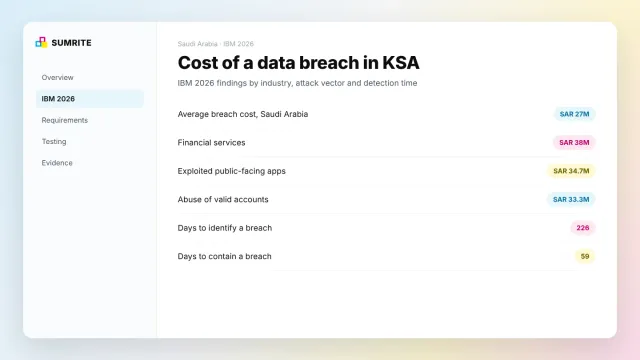
The average data breach in Saudi Arabia cost SAR 27 million in 2026, according to IBM’s 2026 Cost of a Data Breach findings for Saudi Arabia, released in August 2026. IBM’s study period covered breaches from March 2025 to February 2026.
IBM’s Saudi findings link cost directly to how the attacker got in:
| Initial attack vector (Saudi Arabia, IBM 2026) | Average breach cost |
|---|---|
| Exploitation of public-facing applications | SAR 34.7 million |
| Abuse of valid accounts | SAR 33.3 million |
| Phishing (including voice and SMS) | SAR 30.6 million |
IBM also found that 25% of malicious breaches in Saudi Arabia were AI-enabled, and that it took organisations an average of 226 days to identify a breach and a further 59 days to contain it.
Put the two datasets together and they point in the same direction. Positive Technologies sees Saudi attackers using vulnerability exploitation twice as often as the regional average, and IBM finds that breaches through public-facing applications cost Saudi organisations the most. Our full breakdown is in the cost of a data breach in Saudi Arabia.
What do these threats mean for NCA ECC and PDPL obligations?
The threat data maps directly onto controls Saudi organisations already have to meet. The National Cybersecurity Authority’s Essential Cybersecurity Controls (ECC-2:2024) require periodic vulnerability assessment (ECC 2-10), periodic penetration testing (ECC 2-11) and web application security (ECC 2-15).
| Threat pattern in the data | Relevant ECC-2:2024 subdomain |
|---|---|
| Vulnerability exploitation (40% of Saudi attacks) | 2-10 Vulnerability Management · 2-11 Penetration Testing |
| Web resources hit in 49% of regional attacks | 2-15 Web Application Security |
| Malware delivered by email | 2-4 Email Protection |
| Credential theft and valid-account abuse | 2-2 Identity and Access Management |
| Late detection (226 days on average, per IBM) | 2-12 Cybersecurity Event Logs and Monitoring Management |
The ECC-2:2024 document asks for “conducting penetration tests periodically” under 2-11, and for the penetration testing requirements to be reviewed periodically. It does not set a single fixed frequency for all entities, so your own risk assessment and sector regulator set the cadence. Our NCA ECC compliance guide covers the full control set.
When personal data is involved, the Personal Data Protection Law (PDPL), overseen by the Saudi Data & AI Authority (SDAIA), adds a further obligation to protect that data with appropriate safeguards. See our Saudi PDPL compliance guide.
How do you test whether your defences would stop these attacks?
Test the same entry points attackers are using: your internet-facing applications and APIs, your network perimeter, your people and your detection. A manual penetration test of each of these shows which attacks in the data above would succeed against you, and gives you evidence for ECC 2-11.
- Inventory what is exposed. List every domain, portal, API and remote-access service. Start with a free external scan at scan.sumrite.com to see what an attacker sees in one minute.
- Pentest public-facing applications first. IBM’s data shows these are the costliest entry point in Saudi Arabia. Commission web application VAPT and API security testing against the OWASP Top 10 and the OWASP API Security Top 10.
- Test the network perimeter and internal spread. Network VAPT shows whether one exploited server leads to the rest of the estate, which is the ransomware path.
- Test your people. With social engineering in 30% of Saudi attacks, run phishing simulations that include SMS and voice pretexts, not just email.
- Test detection, not just prevention. A red team operation measures whether your SOC notices an intrusion before the 226-day Saudi average.
- Retest after fixes and after major changes. Exploitation windows open every time you ship. Continuous penetration testing (PTaaS) keeps testing in step with releases.
Our pillar guide to penetration testing in Saudi Arabia maps each test type to NCA ECC 2-11 and the SAMA Cyber Security Framework. If you are choosing a vendor, use our buyer’s checklist for Saudi pentest providers, and check what a good deliverable looks like in our sample VAPT report.
What to ask after every test
- Which findings would have allowed initial access, and are they closed?
- Were any stolen-credential paths found (password reuse, missing MFA, exposed tokens)?
- Did monitoring raise an alert during testing, and how long did it take?
- Is there retest evidence an auditor can verify against ECC 2-11?
How Sumrite helps
Sumrite runs penetration testing, phishing simulations and red team operations for Saudi organisations end to end with our verified NCA-registered partner firm, and has served 100+ Saudi clients across Riyadh, Jeddah, Dammam and other cities. Our testers work manually, chaining findings the way the groups above do, and every engagement ends with a retest. Saudi teams can see how we work on our Saudi Arabia page, where we explain how to get a Sumrite VAPT report for Saudi reviews in 48 hours.
Find out which of these attacks would work on you
Tell us what you expose to the internet and we will scope a test against the techniques attackers are using in Saudi Arabia right now. Book a scoping call.
Frequently asked questions
How often is Saudi Arabia targeted by cyber attacks compared with other Middle East countries?
Positive Technologies' Current Cyberthreats in the Middle East report, covering Q2 2025 to Q1 2026, ranked Saudi Arabia the second most targeted country in the region with 12% of successful attacks, behind Israel at 33% and ahead of the UAE at 11%. Positive Technologies also found that Q1 2026 alone accounted for 51% of all attacks recorded in that period.
Which sectors in Saudi Arabia are attacked most often?
Government agencies are the most attacked sector in Saudi Arabia, at 35% of successful attacks between Q2 2025 and Q1 2026 according to Positive Technologies. In Q1 2026 government entities accounted for 71% of attacks on Saudi organisations, with manufacturing and industry, retail and services also heavily targeted.
How do attackers break into Saudi organisations?
Malware is the most common method in attacks on Saudi organisations, used in 55% of cases according to the Positive Technologies executive summary for Q2 2025 to Q1 2026. Vulnerability exploitation followed at 40%, with DDoS and social engineering at 30% each.
What does a data breach cost a Saudi organisation in 2026?
IBM's 2026 Cost of a Data Breach findings for Saudi Arabia put the average breach cost at SAR 27 million. IBM found that breaches starting with exploitation of public-facing applications were the most expensive in the Kingdom, at SAR 34.7 million on average.
How can a Saudi business test whether its defences would stop these attacks?
A Saudi business can test its defences with manual penetration testing of internet-facing web applications, APIs and networks, phishing simulations against staff, and red team exercises that chain techniques the way real attackers do. Penetration testing is also required periodically under NCA ECC-2:2024 control 2-11.
Faisal Khan is a Director at Sumrite, where he oversees penetration testing, risk assessment and compliance engagements for SaaS and enterprise clients. Case studies are anonymised and published with client permission.