On this page
- What are the penalties under the Saudi PDPL?
- When are Saudi PDPL fines doubled?
- What does the PDPL breach notification rule require?
- What has SDAIA enforced under the PDPL so far?
- How does the SDAIA violation procedure work?
- Which security failures lead to PDPL penalties?
- How should a company prepare for SDAIA enforcement?
- How Sumrite helps
- Frequently asked questions
Delivered with a verified NCA-registered partner
Sumrite runs PDPL readiness and VAPT for Saudi organisations end to end with our verified NCA-registered partner firm, and has served 100+ Saudi clients across Riyadh, Jeddah, Dammam and other cities. Talk to our team.
This guide covers the enforcement side of the PDPL: what the penalties are, when they increase, how fast the procedure runs and what SDAIA has penalised so far. For the full set of obligations, start with our Saudi PDPL compliance guide.
What are the penalties under the Saudi PDPL?
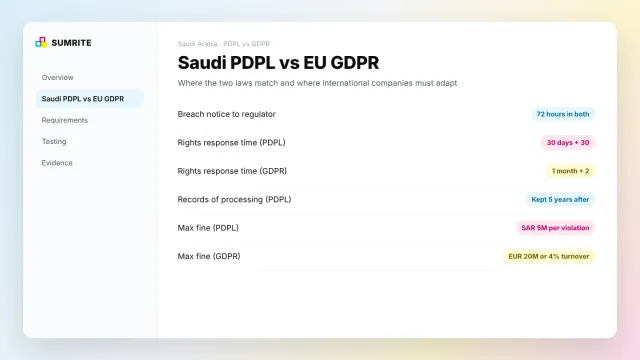
The Saudi PDPL sets two penalty tracks: administrative penalties of a warning or a fine of up to SAR 5 million per violation under Article 36, and criminal penalties of up to two years’ imprisonment and a fine of up to SAR 3 million under Article 35 for unlawfully disclosing or publishing sensitive data. Article 36 penalties are imposed by SDAIA’s violation committees; Article 35 cases go through the Public Prosecution and the courts.
The English text of the Personal Data Protection Law is published by SDAIA, and the authoritative Arabic text is on the Bureau of Experts portal.
| Penalty | Trigger | Ceiling | Decided by |
|---|---|---|---|
| Warning or fine (Article 36) | Any violation of the PDPL or its regulations not covered by Article 35 | SAR 5 million per violation | SDAIA violation committees, appealable to court |
| Imprisonment and/or fine (Article 35) | Disclosing or publishing sensitive data with intent to harm the data subject or for personal benefit | Two years and SAR 3 million | Public Prosecution and competent court |
| Repeat violation | A further violation after a final penalty | Fine can be doubled | Committee or court |
| Confiscation | Funds obtained through the violation | Amount obtained | Competent court |
| Publication | Final penalty decision | Published at the violator’s expense | Committee or court |
| Compensation | Material or moral damage to an individual | Assessed by the court | Competent court |
“Per violation” matters. A single marketing campaign sent to thousands of people without consent, or a single unprotected database, can be framed as more than one violation. That is why the ceiling is a poor guide to exposure and why the categories SDAIA has already enforced deserve more attention.
When are Saudi PDPL fines doubled?
Saudi PDPL fines can be doubled when the same violator commits a repeat violation, and the doubled amount may exceed the normal SAR 5 million ceiling but not twice that limit. DLA Piper’s Saudi Arabia summary (last updated February 2026) describes the doubling rule in those terms.
Repeat exposure is the practical risk for companies that treat a first decision as a one-off. If the committee penalises you for missing safeguards on one portal and a second portal with the same weakness is found later, you are in repeat territory. Close the root cause across every system, not just the one named in the decision.
Publication is the other multiplier. The committees can require final penalties to be published, as Clyde & Co notes in its March 2026 analysis of PDPL enforcement. For a consumer brand or a vendor bidding on Saudi contracts, a published decision can cost more than the fine.
What does the PDPL breach notification rule require?
The PDPL breach notification rule requires a controller to notify SDAIA within 72 hours of becoming aware of a personal data breach that may harm individuals, under Article 24 of the PDPL Implementing Regulation, and to notify affected individuals without undue delay where the breach may cause them harm. Notifications are submitted through SDAIA’s National Data Governance Platform.
Seventy-two hours runs through weekends and public holidays. Decide in advance:
- Who confirms that an incident involves personal data and starts the 72-hour clock
- Who assesses harm and decides whether individuals must be told
- Who drafts the notice and who holds credentials to submit it on the platform
- Which processors must tell you about a breach, and how fast, under your contracts
- Which other regulators need notice, for example NCA, SAMA or CST in regulated sectors
The rule may tighten. SDAIA’s October 2026 draft amendments to the Implementing Regulation, open for comment until 5 November 2026, would keep the 72-hour window but drop the harm test for notifying SDAIA, so more incidents would be reportable. As of 11 November 2026 the draft has not been adopted. Our analysis of the draft PDPL Implementing Regulation amendments explains the change.
What has SDAIA enforced under the PDPL so far?
On 16 January 2026 the Saudi Press Agency reported that SDAIA’s committees for reviewing PDPL violations had issued 48 decisions confirming violations and enforcing the prescribed penalties on data controllers during the previous year, under Article 36 of the PDPL. The four violation types named were everyday operational failures.
| Violation type named by SDAIA | Typical root cause |
|---|---|
| Collecting and processing personal data in breach of the law | No lawful basis recorded; data collected “just in case” |
| Disclosing personal data without legal justification | Sharing with partners, agencies or group companies with no basis or agreement |
| Failing to implement organisational, administrative and technical safeguards | Untested portals, weak access control, missing logs |
| Sending advertising and marketing messages without consent | SMS and WhatsApp campaigns to customers who never opted in |
The controllers’ names and the fine amounts have not been published. An earlier Saudi Press Agency statement from April 2025 confirmed the committees include technical and legal experts and can summon people and entities to give testimony or reports.
How does the SDAIA violation procedure work?
SDAIA’s violation committees run PDPL cases mainly through an electronic platform with short deadlines: five days to respond to a notice of an alleged violation, notification of the decision within 15 days of issue, and 60 days from notification to appeal to the competent court. Those deadlines come from SDAIA’s Rules of Procedure for the violation committees, as summarised by Clyde & Co in March 2026.
Complaint or SDAIA review
A data subject complaint, a breach report or SDAIA's own monitoring opens a case.
Notice of alleged violation
Delivered through the electronic platform. An authorised representative must upload proof of authority before seeing the statement of claim.
Five days to respond
Written response with evidence. The committee can request documents, appoint experts and hold hearings, including virtual ones.
Decision
Warning or fine under Article 36. Notified within 15 days of issue; publication may be ordered.
Appeal
To the competent court within 60 days of notification.
Five days is very little time if nobody knows who holds the power of attorney or the platform login. Settle both now.
Which security failures lead to PDPL penalties?
The security failure that leads to PDPL penalties is the absence of appropriate organisational, administrative and technical safeguards for personal data, which Article 19 of the PDPL requires and which SDAIA named as one of its four enforced violation types in January 2026. The law does not list specific controls, so the controller has to show that its measures were appropriate and worked.
The persuasive answer to a committee is evidence, not a policy document:
- a recent web application penetration test of every portal holding personal data, with findings retested and closed;
- API security testing of services that pass personal data to apps, partners and processors;
- a cloud security assessment of the environments storing Saudi personal data;
- vulnerability management records, access reviews and logs;
- a breach plan that has been rehearsed against the 72-hour window.
That is where VAPT stops being an IT line item and becomes part of your legal defence. Our guide to penetration testing in Saudi Arabia explains how to scope tests so the report doubles as PDPL and NCA evidence, and a sample VAPT report shows what that evidence looks like.
How should a company prepare for SDAIA enforcement?
A company should prepare for SDAIA enforcement by fixing the four violation types SDAIA has already penalised, rehearsing the 72-hour breach notice and making sure it can answer a violation notice within five days. The 90-day plan below gets most organisations there.
- Days 1 to 30: get findable. Confirm who holds power of attorney and platform access for SDAIA proceedings. Inventory processing activities: data, lawful basis and systems. Freeze marketing to any list without provable consent.
- Days 31 to 60: close the obvious gaps. Fix lawful-basis gaps and update privacy notices. Put data-sharing and processing agreements in place. Penetration test the systems holding personal data, starting with customer portals and apps.
- Days 61 to 90: prove it. Run a 72-hour breach tabletop. Set up a data subject request workflow with its 30-day deadline. Assemble an evidence binder of records of processing, test reports, remediation and training.
Use our PDPL compliance checklist to track each item, and our Saudi PDPL vs GDPR comparison if your programme was built for Europe first.
How Sumrite helps
Sumrite’s Saudi PDPL compliance service covers gap assessment, records of processing, consent and notice remediation and breach-response readiness. Our VAPT, delivered end to end with our verified NCA-registered partner firm, produces the technical-safeguard evidence a committee will ask for, and our Saudi landing page explains how we deliver a Sumrite VAPT report for Saudi reviews in 48 hours. We have served 100+ Saudi clients across Riyadh, Jeddah, Dammam and other cities.
Be ready before the notice arrives
Tell us which systems hold Saudi personal data and we will scope the readiness review and the testing that backs it. Book a scoping call.
Frequently asked questions
What is the maximum PDPL fine in Saudi Arabia?
The maximum Saudi PDPL fine for a general violation is SAR 5 million per violation under Article 36, and SDAIA's committees can issue a warning instead. The fine can be doubled for a repeat violation. Disclosing sensitive personal data with intent to harm or for personal benefit carries up to two years' imprisonment and a fine of up to SAR 3 million under Article 35.
How many PDPL enforcement decisions has SDAIA issued?
On 16 January 2026 the Saudi Press Agency reported that SDAIA's committees for reviewing PDPL violations had issued 48 decisions confirming violations and enforcing penalties on data controllers during the previous year. The decisions covered unlawful collection and processing, disclosure without legal justification, missing safeguards and marketing without consent.
What is the PDPL breach notification deadline?
The PDPL breach notification deadline is 72 hours from becoming aware of a personal data breach, under Article 24 of the PDPL Implementing Regulation. Controllers notify SDAIA through the National Data Governance Platform, and notify affected individuals without undue delay where the breach may harm them.
How quickly must a company respond to an SDAIA violation notice?
A company has five days to respond after being notified of an alleged PDPL violation, according to Clyde & Co's March 2026 analysis of the Rules of Procedure for SDAIA's violation committees. Committee decisions are notified within 15 days of issue, and appeals go to the competent court within 60 days of notification.
Can PDPL penalties be published?
Yes. A Saudi PDPL penalty decision can be ordered to be published at the violator's expense, and a court can also confiscate funds obtained through the violation. Individuals harmed by a violation can separately claim compensation for material or moral damage.
Faisal Khan is a Director at Sumrite, where he oversees penetration testing, risk assessment and compliance engagements for SaaS and enterprise clients.