On this page
- What is the difference between NCA ECC and SAMA CSF?
- Do Saudi financial institutions have to comply with both NCA ECC and SAMA CSF?
- How do NCA ECC domains map to SAMA CSF domains?
- How can one penetration testing programme satisfy both NCA ECC 2-11 and SAMA CSF 3.2.4?
- Where do NCA ECC and SAMA CSF differ in ways that matter?
- How should you build a dual-compliance control register?
- How Sumrite helps
- Frequently asked questions
Delivered with a verified NCA-registered partner
Sumrite runs dual-compliance testing programmes for Saudi financial institutions end to end with our verified NCA-registered partner firm, and has served 100+ Saudi clients across Riyadh, Jeddah, Dammam and other cities. Talk to our team.
Saudi compliance teams often run two parallel programmes, one for NCA and one for SAMA, with two control registers, two testing calendars and two sets of reports. That doubles effort without adding assurance. This guide compares the frameworks using their own text and shows how to merge the work. For each framework on its own, see our SAMA Cyber Security Framework guide and our NCA ECC compliance guide.
What is the difference between NCA ECC and SAMA CSF?
NCA ECC-2:2024 is a national cybersecurity baseline for government entities and CNI operators, while the SAMA Cyber Security Framework is a sector framework for SAMA-regulated financial institutions assessed against a maturity model. ECC is measured by control compliance; SAMA CSF is measured by maturity level, with level 3 as the minimum.
| Dimension | NCA ECC-2:2024 | SAMA Cyber Security Framework |
|---|---|---|
| Issuer | National Cybersecurity Authority (NCA) | Saudi Central Bank (SAMA) |
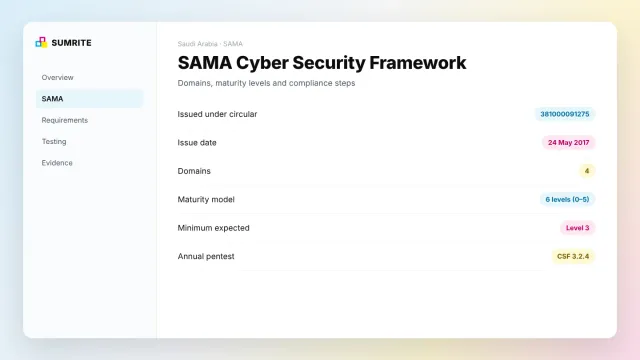
| Current text | ECC-2:2024 | Issued under Circular 381000091275, 24 May 2017 |
| Who it covers | Government entities, their affiliates, and private entities that own, operate or host CNI | All SAMA Member Organizations: banks, insurers and reinsurers, financing companies, credit bureaus, financial market infrastructure |
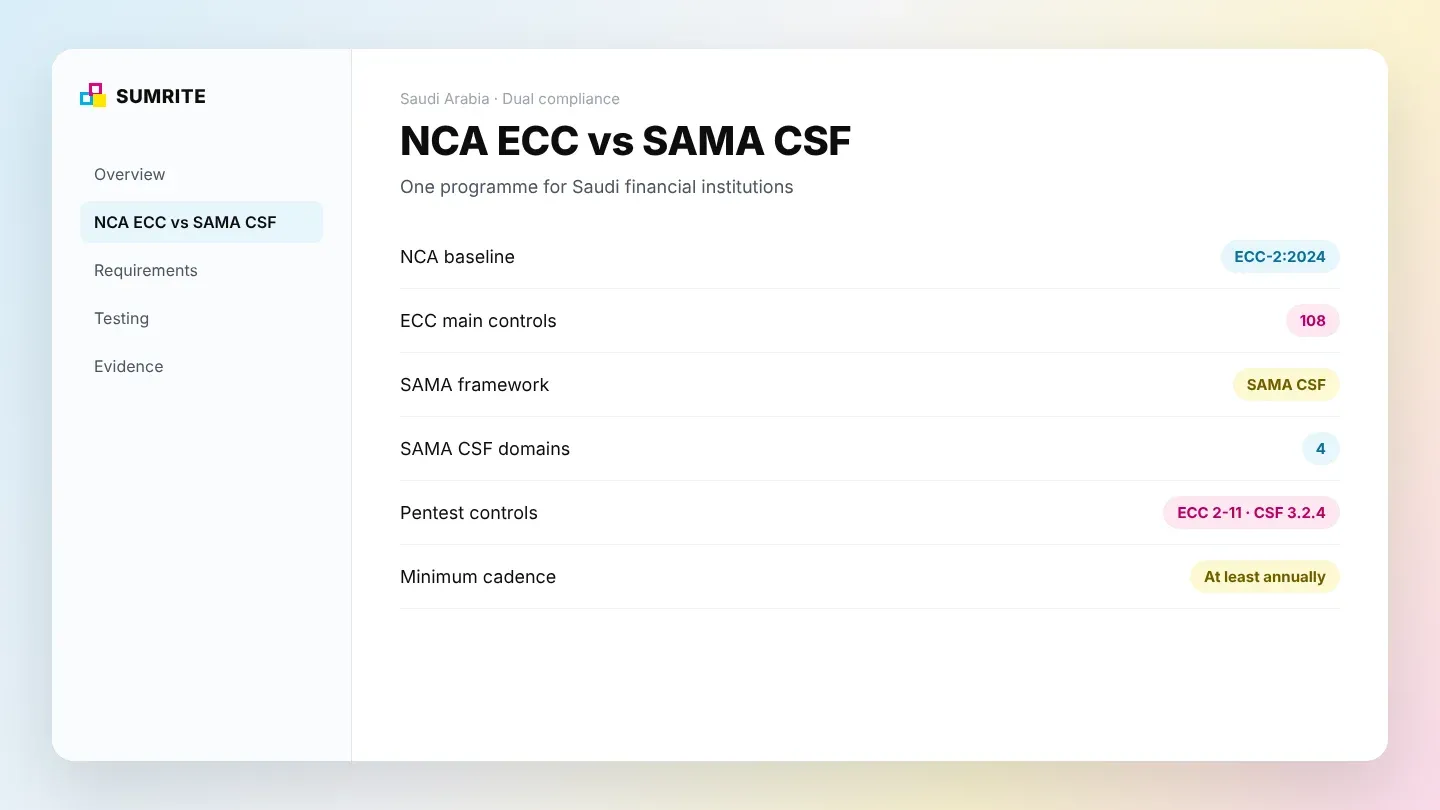
| Structure | 4 main domains, 28 subdomains, 108 main controls, 92 subcontrols | 4 domains (3.1 to 3.4) with subdomains of principles, objectives and control considerations |
| Assessment model | Compliance with each control | Maturity levels 0 to 5; at least level 3 expected |
| Penetration testing | 2-11: periodic tests of all internet-facing services | 3.2.4: annual review and penetration tests of customer and internet-facing services |
The ECC figures come from the ECC-2:2024 document published by NCA. The SAMA figures come from the framework introduction, its applicability section and its maturity model on the SAMA Rulebook. Note that ECC is not certifiable: there is no “ECC certificate”, only compliance with the controls.
Do Saudi financial institutions have to comply with both NCA ECC and SAMA CSF?
Every SAMA Member Organization must comply with the SAMA Cyber Security Framework, and a financial institution must also comply with NCA ECC-2:2024 when it owns, operates or hosts Critical National Infrastructure or is a government-affiliated entity. Large banks, payment infrastructure and market infrastructure are the institutions most likely to sit in both scopes.
ECC-2:2024 states that it applies to government agencies, their affiliated companies and entities inside and outside the Kingdom, and private-sector entities that own, operate or host CNI, and NCA encourages all other entities to use the controls. Whether a specific institution is treated as CNI is a determination for the regulators, not something to assume. The safe working rule we use: if your institution has been told by NCA that it is in scope, or is government-owned or affiliated, plan for dual compliance and confirm the position with your compliance function.
Fintechs at the sandbox or licensing stage sit under SAMA’s Cyber Resilience Fundamental Requirements (CRFR) first, and move to the full SAMA CSF once licensed. ICT and hosting providers that serve banks may also answer to the CST Cybersecurity Regulatory Framework.
How do NCA ECC domains map to SAMA CSF domains?
NCA ECC’s four domains map closely onto SAMA CSF’s four domains: ECC Governance aligns with SAMA 3.1 and 3.2, ECC Defense with SAMA 3.3, ECC Resilience with SAMA’s incident and event management subdomains, and ECC Third-Party and Cloud with SAMA 3.4. The mapping below is Sumrite’s working mapping, not an official crosswalk.
| NCA ECC-2:2024 domain | Closest SAMA CSF domain and subdomains |
|---|---|
| 1 Cybersecurity Governance | 3.1 Leadership and Governance (3.1.1 to 3.1.7); 3.2 Risk Management and Compliance (3.2.1, 3.2.2, 3.2.5) |
| 2 Cybersecurity Defense | 3.3 Operations and Technology (3.3.3 Asset Management, 3.3.5 IAM, 3.3.6 Application Security, 3.3.8 Infrastructure Security, 3.3.9 Cryptography, 3.3.17 Vulnerability Management); 3.2.4 Cyber Security Review |
| 3 Cybersecurity Resilience | 3.3.14 Event Management and 3.3.15 Incident Management, together with SAMA’s separate Business Continuity Management framework |
| 4 Third-Party and Cloud Computing Cybersecurity | 3.4 Third Party Cyber Security (3.4.1 Contract and Vendor Management, 3.4.2 Outsourcing, 3.4.3 Cloud Computing) |
The SAMA subdomain names are from SAMA CSF Section 3, Control Domains. The most useful pairs for testing work are ECC 2-11 Penetration Testing with SAMA CSF 3.2.4 Cyber Security Review, and ECC 2-10 Vulnerabilities Management with SAMA CSF 3.3.17 Vulnerability Management.
How can one penetration testing programme satisfy both NCA ECC 2-11 and SAMA CSF 3.2.4?
One penetration testing programme satisfies both frameworks when its scope is the union of both lists, its cadence is the stricter of the two, and every finding and retest is mapped to both control references. That means scoping every internet-facing component named in ECC 2-11-3-1 and every customer and internet-facing service under SAMA CSF 3.2.4, at least annually.
The two control texts line up well:
- Scope. ECC 2-11-3-1 requires the scope to include all internet-facing services and their technical components: infrastructure, websites, web applications, smartphone and tablet applications, email and remote access. SAMA CSF 3.2.4 covers customer and internet facing services.
- Frequency. ECC 2-11-3-2 requires tests to be conducted periodically; SAMA CSF 3.2.4 says annual. Annual is therefore the floor for a dual programme, and SAMA CSF 3.3.7 adds penetration testing of changes where applicable.
- Follow-up. ECC 2-11-4 requires the implementation of the penetration testing requirements to be periodically reviewed; SAMA CSF 3.2.4 requires follow-up reviews to confirm issues were addressed. A retest closes both.
- Build one service inventory. List every internet-facing service and component, tagged with ECC 2-11-3-1 category and SAMA CSF 3.2.4 relevance.
- Write one penetration testing standard. State the annual minimum, change-driven testing, methodology and rules of engagement; approve it through governance so it meets SAMA maturity level 3 and ECC 2-11-1.
- Scope tests by asset type. Use web application VAPT, mobile app VAPT, API security testing and network VAPT so every listed component is covered.
- Map findings to both frameworks. Each finding carries its ECC control and SAMA subdomain reference in the report.
- Retest and close. Keep remediation tracking and retest reports as the shared follow-up evidence.
- Report once, file twice. Use the same report pack for NCA compliance submissions and SAMA reviews.
Our ECC-2:2024 penetration testing guide and SAMA penetration testing guide cover each control in more depth, and the Saudi penetration testing pillar guide maps every test type to both.
Where do NCA ECC and SAMA CSF differ in ways that matter?
The differences that matter most are ECC’s Saudi-staffing and in-Kingdom managed-service rules, SAMA’s maturity model and red teaming framework, and SAMA’s exclusions for non-bank institutions. A merged programme has to carry the stricter requirement from each side.
- ECC 1-2-2 staffing
- All cybersecurity positions shall be filled with full-time, qualified Saudi cybersecurity professionals.
- ECC 4-1-3 managed services
- Managed service centres using remote access must be fully located inside Saudi Arabia.
- SAMA maturity model
- Each SAMA CSF subdomain is scored 0 to 5 and must reach at least level 3 (structured and formalized).
- SAMA non-bank exclusions
- Subdomains 3.2.3, 3.3.12 and 3.3.13 are excluded for non-banks, with PCI, SWIFT CSCF or MFA conditions instead.
- SAMA red teaming
- The FEER framework expects threat-intelligence-based red teaming at least once every three years. See [SAMA red teaming vs penetration testing](/blog/sama-red-teaming-vs-penetration-testing).
The ECC 4-1-3 rule affects how you buy ongoing services: where a cybersecurity provider delivers a managed service over remote access, that service centre has to sit inside Saudi Arabia, so check the delivery model in the contract before signing. Our vendor risk and TPRM page covers how to evidence third-party controls for both ECC 4-1 and SAMA CSF 3.4.
How should you build a dual-compliance control register?
Build a single control register in which each row is an NCA ECC control or SAMA CSF subdomain, cross-referenced to the other framework, with one owner, one evidence set and both a compliance status and a SAMA maturity score. That lets one piece of evidence close two requirements.
- One row per ECC control, with the mapped SAMA CSF subdomain in a second column.
- SAMA-only rows for subdomains without a clear ECC match, such as 3.3.12 Payment Systems and 3.3.13 Electronic Banking Services.
- An evidence link per row: policy, approval record, implementation proof and monitoring KPI.
- A SAMA maturity score (0 to 5) alongside the ECC compliance status for each row.
- A testing column linking the latest penetration test, retest and vulnerability scan evidence.
- A review date per row, so ECC 2-11-4 periodic review and SAMA level 3 monitoring are visible.
The NCA ECC compliance page explains how Sumrite supports ECC programmes, and our ISO 27001 VAPT audit guide helps if the institution also holds an ISO 27001 certification that can share evidence.
How Sumrite helps
Sumrite runs one penetration testing programme for Saudi financial institutions that serves NCA ECC 2-11 and SAMA CSF 3.2.4 together, end to end with our verified NCA-registered partner firm. Each report maps findings to both frameworks, includes a retest, and comes with an evidence pack ready for NCA submissions and SAMA reviews. We have served 100+ Saudi clients across Riyadh, Jeddah, Dammam and other cities, and Saudi teams can start on our Saudi Arabia page, where a VAPT report for Saudi reviews is delivered in 48 hours.
One programme, two regulators
Share your list of internet-facing services and your SAMA category, and we will scope one penetration testing programme mapped to both NCA ECC 2-11 and SAMA CSF 3.2.4. Book a scoping call.
Frequently asked questions
What is the difference between NCA ECC and SAMA CSF?
NCA ECC-2:2024 is the National Cybersecurity Authority's national baseline of 108 main controls for government entities and private entities that own, operate or host Critical National Infrastructure. The SAMA Cyber Security Framework is the Saudi Central Bank's sector framework for banks, insurers, financing companies, credit bureaus and the financial market infrastructure, assessed against a maturity model with a level 3 minimum.
Do Saudi banks have to comply with both NCA ECC and SAMA CSF?
Every Saudi bank must comply with the SAMA Cyber Security Framework because it applies to all SAMA Member Organizations. A bank must also comply with NCA ECC-2:2024 when it owns, operates or hosts Critical National Infrastructure, or when it is a government-affiliated entity, so many large financial institutions work to both frameworks.
Can one penetration test satisfy both NCA ECC and SAMA CSF?
One penetration testing programme can satisfy both NCA ECC 2-11 and SAMA CSF 3.2.4 if its scope covers every internet-facing service listed in ECC 2-11-3-1 and every customer and internet-facing service under SAMA CSF 3.2.4. The programme should test at least annually, follow up with retests, and map each finding to both control references in the report.
How often does NCA ECC require penetration testing compared with SAMA?
NCA ECC-2:2024 control 2-11-3-2 requires penetration tests to be conducted periodically and leaves the interval to the entity's approved requirements. SAMA CSF 3.2.4 is more specific and requires annual review and penetration tests of customer and internet-facing services, so a dual-compliance programme should test at least annually.
Is there an official mapping between NCA ECC and SAMA CSF?
Neither the National Cybersecurity Authority nor SAMA publishes an official crosswalk in the ECC-2:2024 or SAMA Cyber Security Framework texts. Financial institutions usually build their own mapping in a single control register and record, for each control, the ECC reference, the SAMA CSF subdomain and the shared evidence.
Faisal Khan is a Director at Sumrite, where he oversees penetration testing, risk assessment and compliance engagements for SaaS and enterprise clients. Case studies are anonymised and published with client permission.